


Author’s Note: For a summary of why voter registration by party is so important, and to understand the importance of these states and why each were selected for this recurring study, please see the March 2025 summary.
Last month’s report can be found here.
FLORIDA
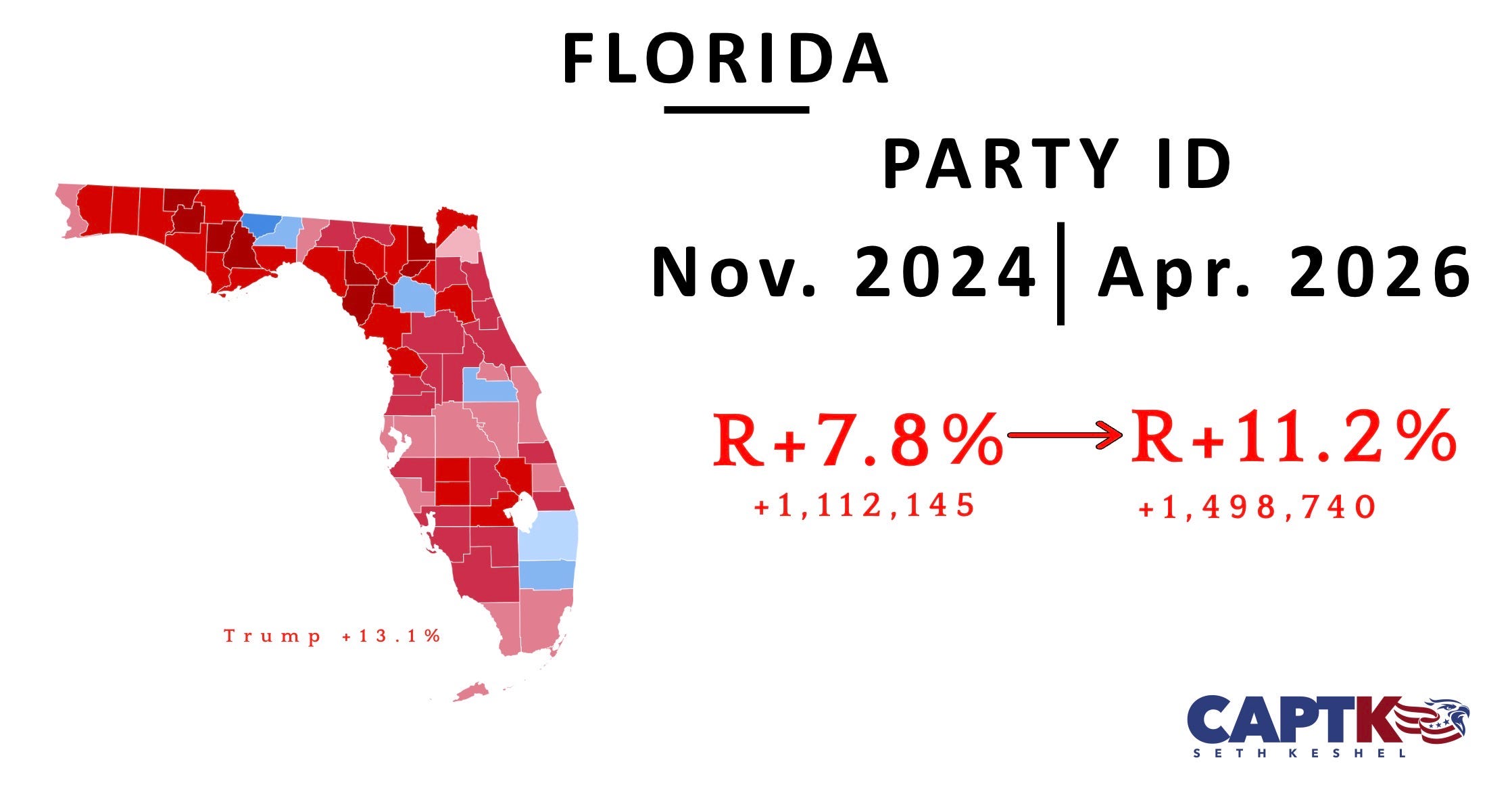
Net Shift Since March: R+4,964
This is the smallest monthly net gain for the GOP since I’ve been tracking this data in these monthly articles (March 2025), but it is primary season and both parties are registering voters. Nevertheless, Republicans continue to put distance between themselves and Democrats, sustaining the Sunshine State’s push to become redder than Texas in the next presidential election.
Duval County has shifted to within 5,000 for the fading Democrat registration advantage, which suggests Georgia is also getting redder. Duval has shifted nearly 8,000 net registrations toward the GOP since November 2024.
Florida’s drift is predictive for Pennsylvania and Michigan since 1952, portending good things for future GOP campaigns in both of those battlegrounds in the next presidential election.
IOWA
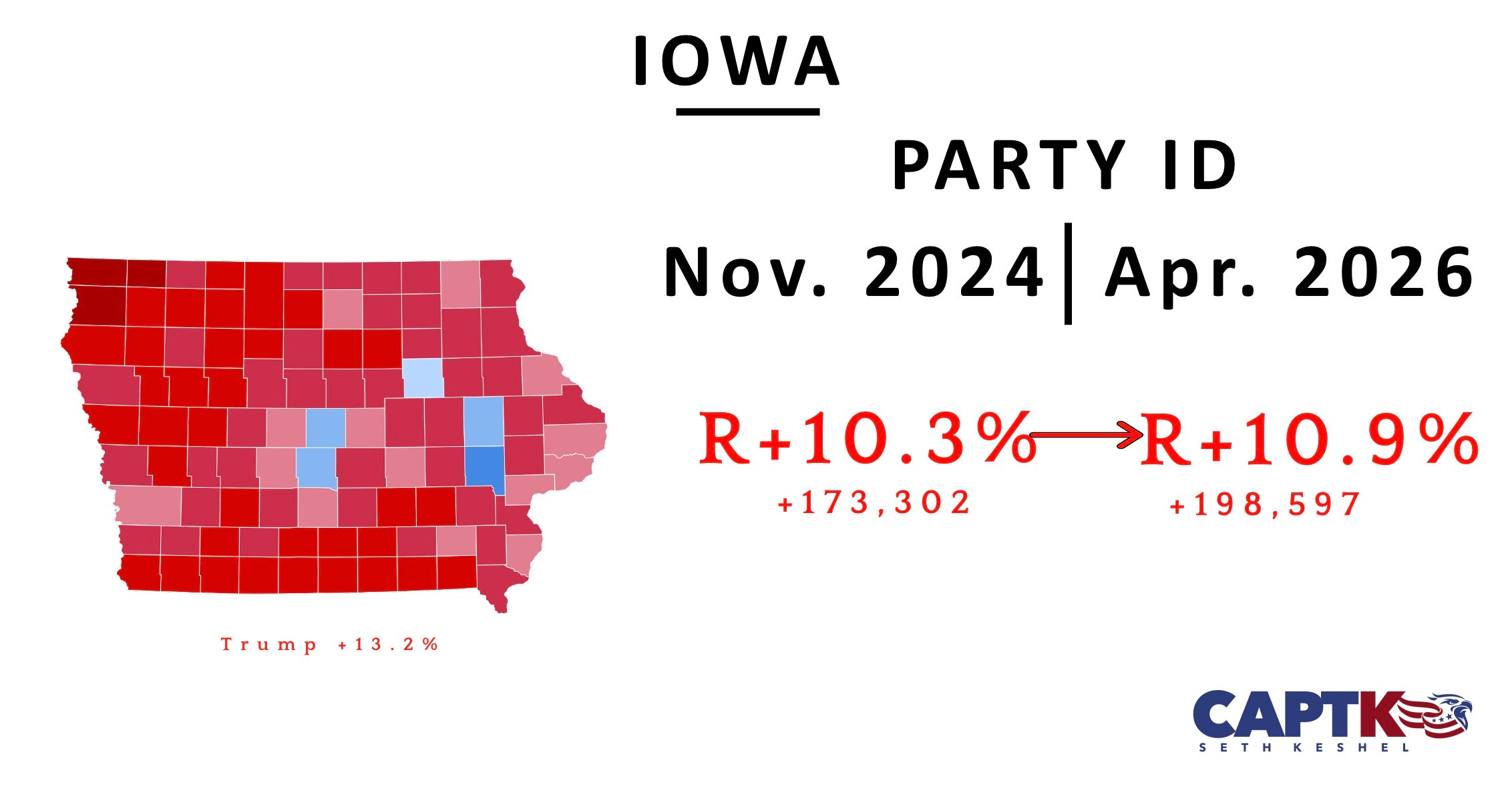
Net Shift Since March: R+350
Republicans outpaced their net February gains, with both parties slightly increasing their registration counts. With Iowa’s primary looming on June 2, the lack of any net Democrat gains by now since I’ve been tracking these monthly changes is telling that they’ve lost their resiliency in the Upper Midwest.
Iowa is no longer playable for Democrats at the state level, but will have two competitive U.S. House races this year; most importantly, the state tracks with Wisconsin and Minnesota as a proxy, given that those two states don’t register voters by party.
PENNSYLVANIA
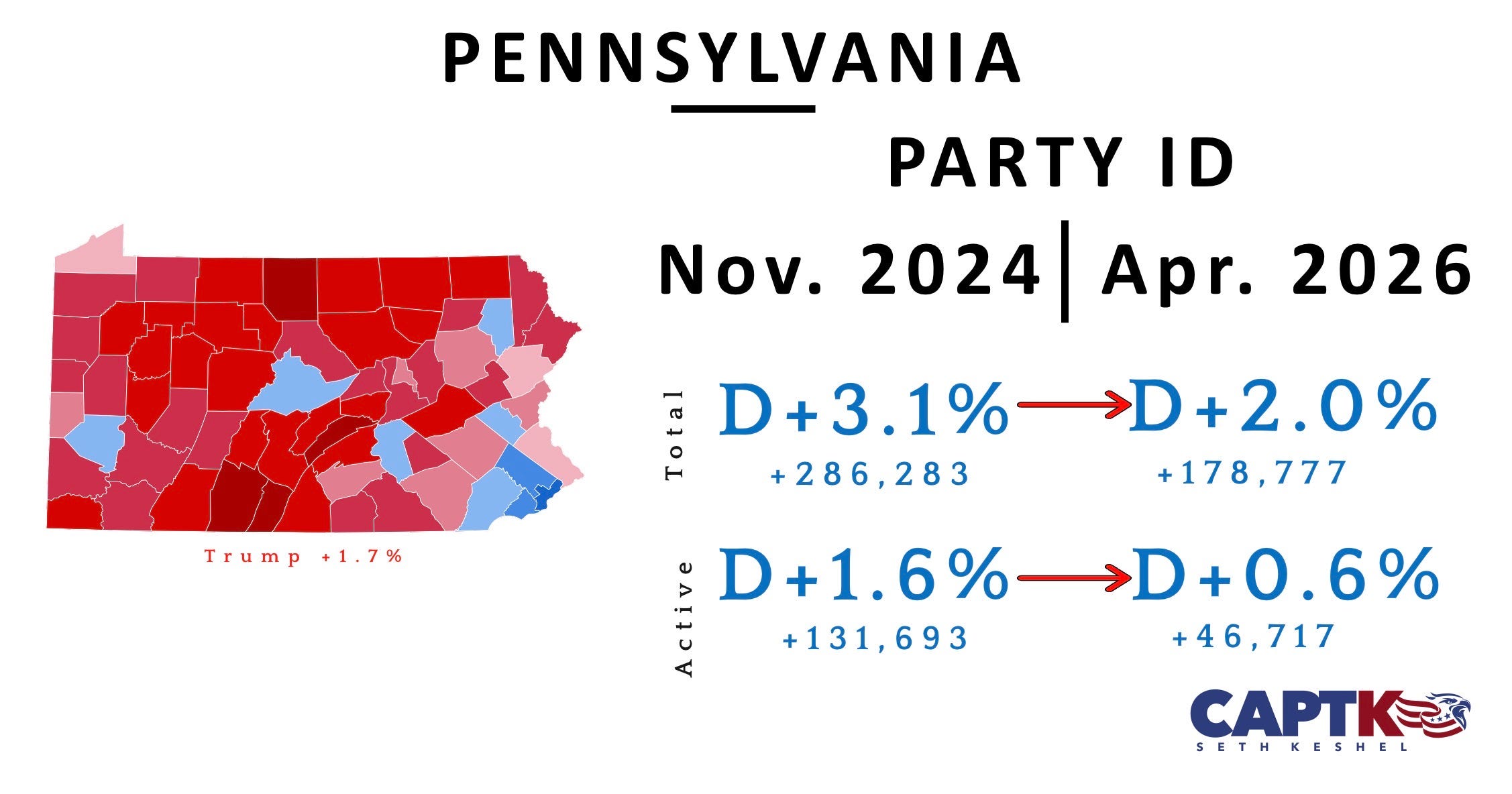
Net Shift Since March: D+3,010 Total, D+1,458 Active
For the second month in a row, the numbers look bad on surface level, with Democrats clawing back GOP gains that have been continuous for 16 years. There continues to be a strange discrepancy between Democrat overall gains and a much lower correlation to gains on the active voter roll I’m still trying to figure out. I suspect the recent changes have more to do with the May primary than anything else.
Now, for the silver linings. Republicans had more party switchers in their favor than the other way around, and the key takeaway is that, despite substantial Democrat gains in statewide numbers, Erie and Northampton Counties (the two key blue collar bellwethers) are both less blue by active registration (by 25 and 53 registrations, respectively) than they were two months ago. There does not appear to be a legitimate coalition shift away from MAGA in Pennsylvania with the working-class voter.
Democrats have still lost a ton of their dwindling advantage since the November 2024 election, and it is possible Pennsylvania is the new Ohio - a true national bellwether with an elastic independent voter base.
NORTH CAROLINA
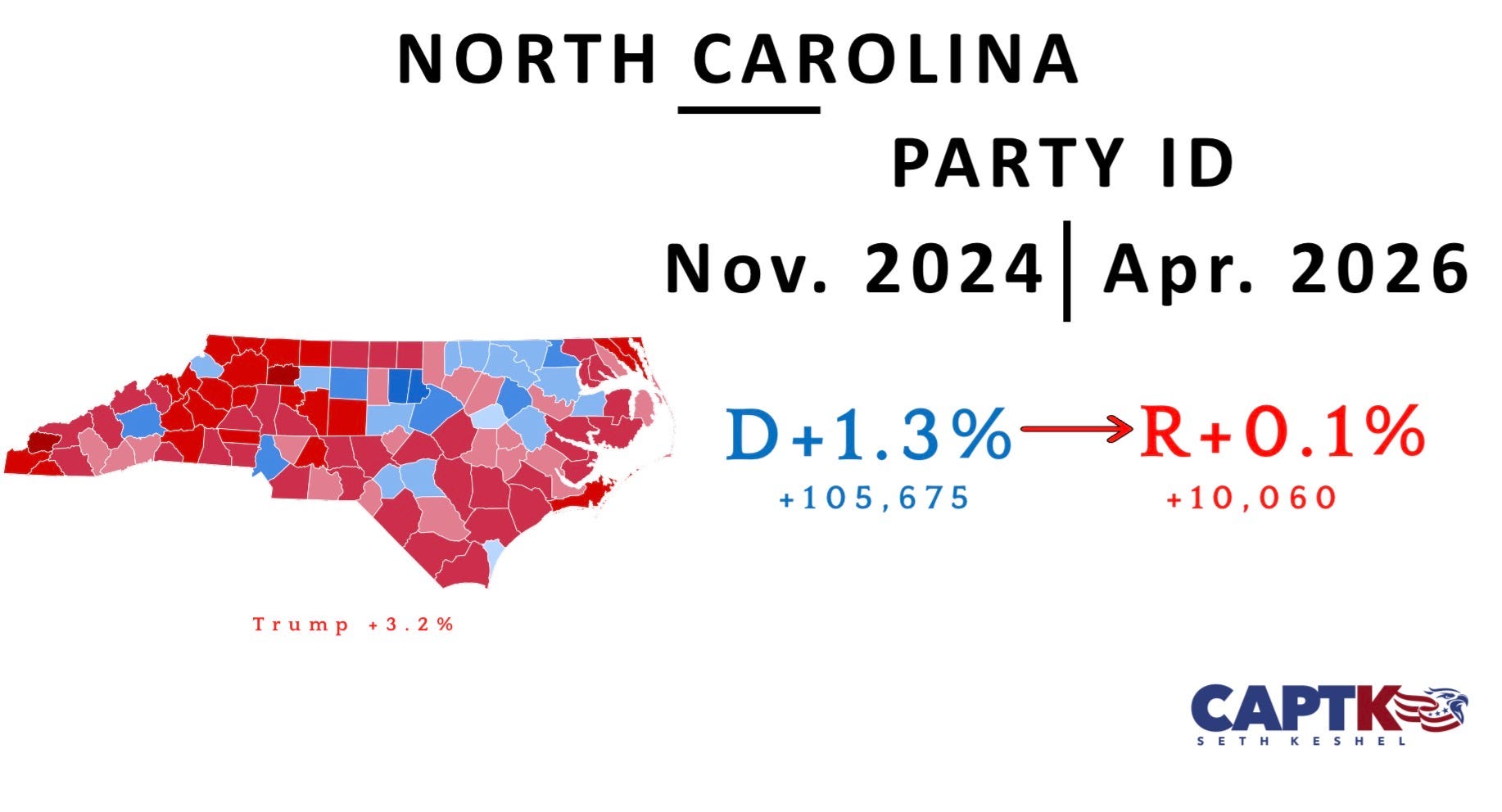
Net Shift Since March: R+1,289
With the North Carolina primary over, Republicans resumed steady gains for the rest of the month of March. Their registration advantage sits over 10,000 to begin April, but a heated Senate race will likely make urban areas competitive for these measurements for the rest of the year.
With former Democrat Governor Roy Cooper running for U.S. Senate, Republicans need all the help they can get. I consider the GOP-held seat in North Carolina the most likely to flip to Democrats in 2026, with Michael Whatley the Republican nominee.
NEW HAMPSHIRE
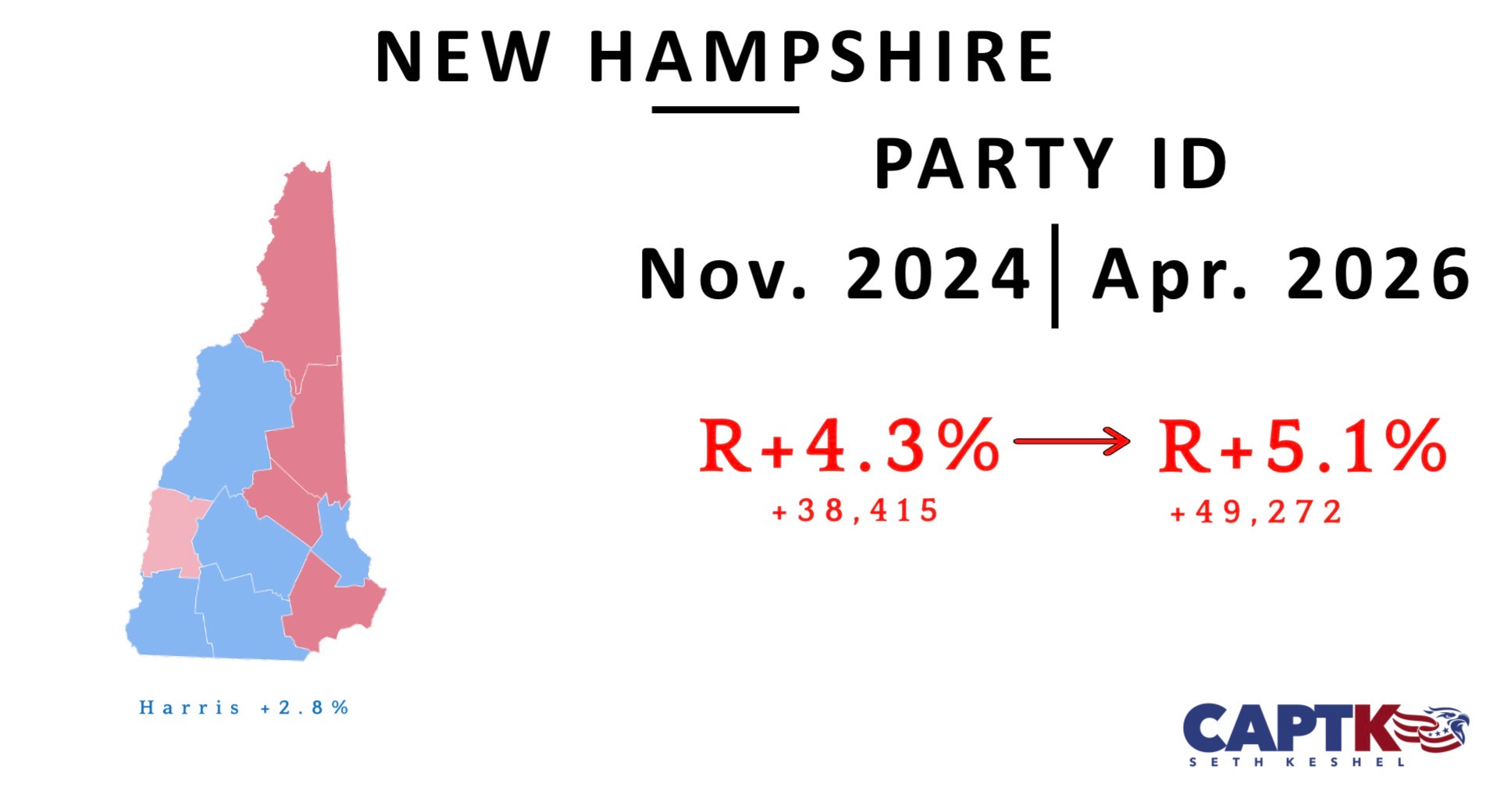
Net Shift Since March: None
New Hampshire releases quarterly updates and isn’t due for another until May 2026.
The Granite State remains the most likely Republican flip for the 2028 presidential election, and has several important races on the ballot in 2026, like a U.S. Senate seat and the battle for NH-1, which Democrat Chris Pappas will vacate to run for that Senate seat.
ARIZONA
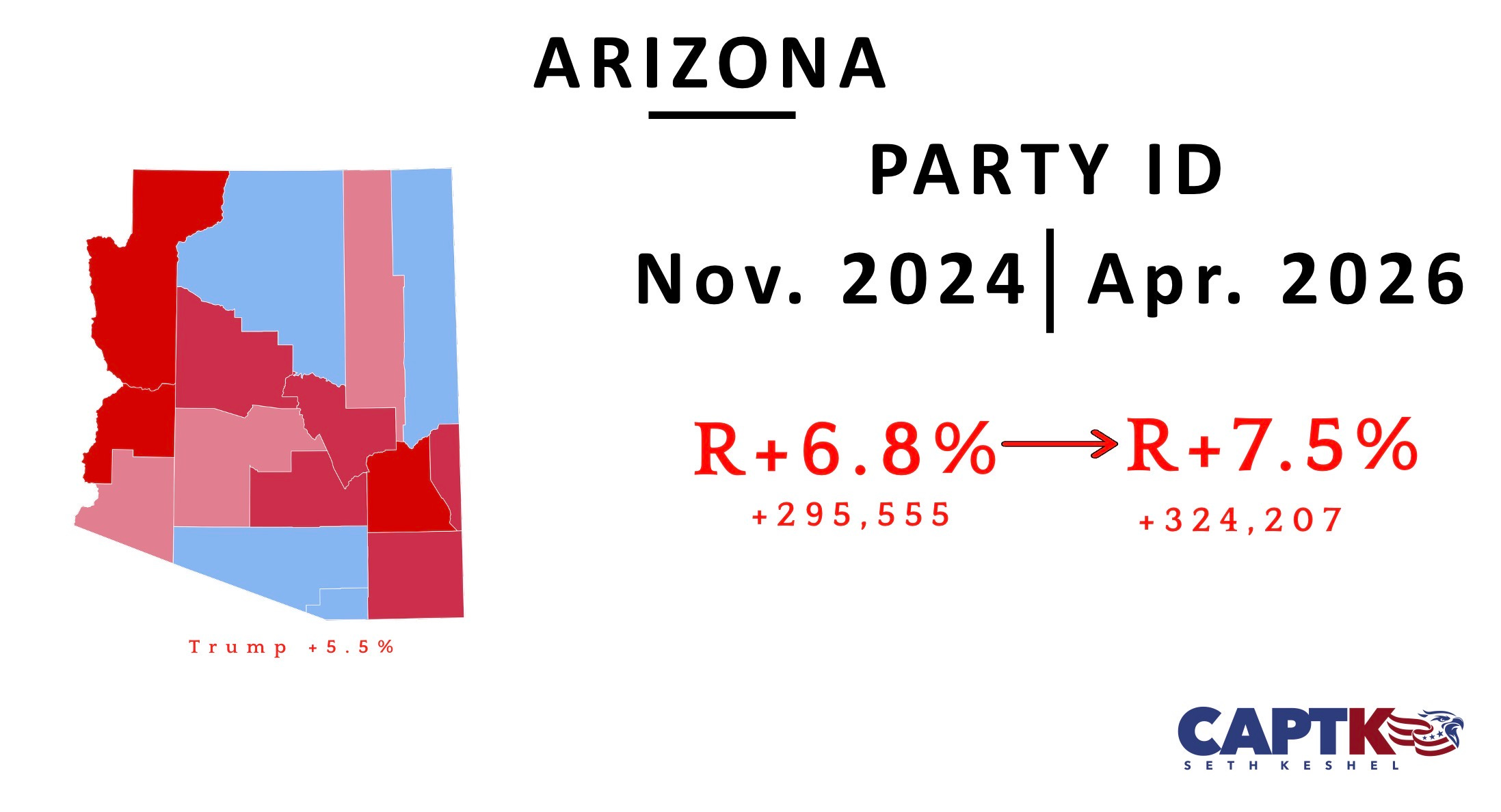
Net Shift Since March: D+2,881
My unofficial numbers for Arizona registrations include constant updates for Maricopa and Pima Counties, which I have access to. We will likely receive a Secretary of State update soon (perhaps as early as this month) to paint a full picture of the statewide trend, so things won’t be as negative as they appear to be on surface level here given the trends in the outlying 13 counties.
Democrat net gains in the two major urban counties mirror those reported last month. Republicans are adding new active registrations in large quantities in Maricopa County, but still being outpaced after years of dormancy from Democrats. I have no proof (yet), but am not confident these registrations are growing organically for that party (Democrats). Either way, they are engaging heavily to get their number up after five years of getting trounced.
Expect Democrats to pull out all the stops to save Katie Hobbs and her cohort of corrupt statewide officers this fall.
NEVADA
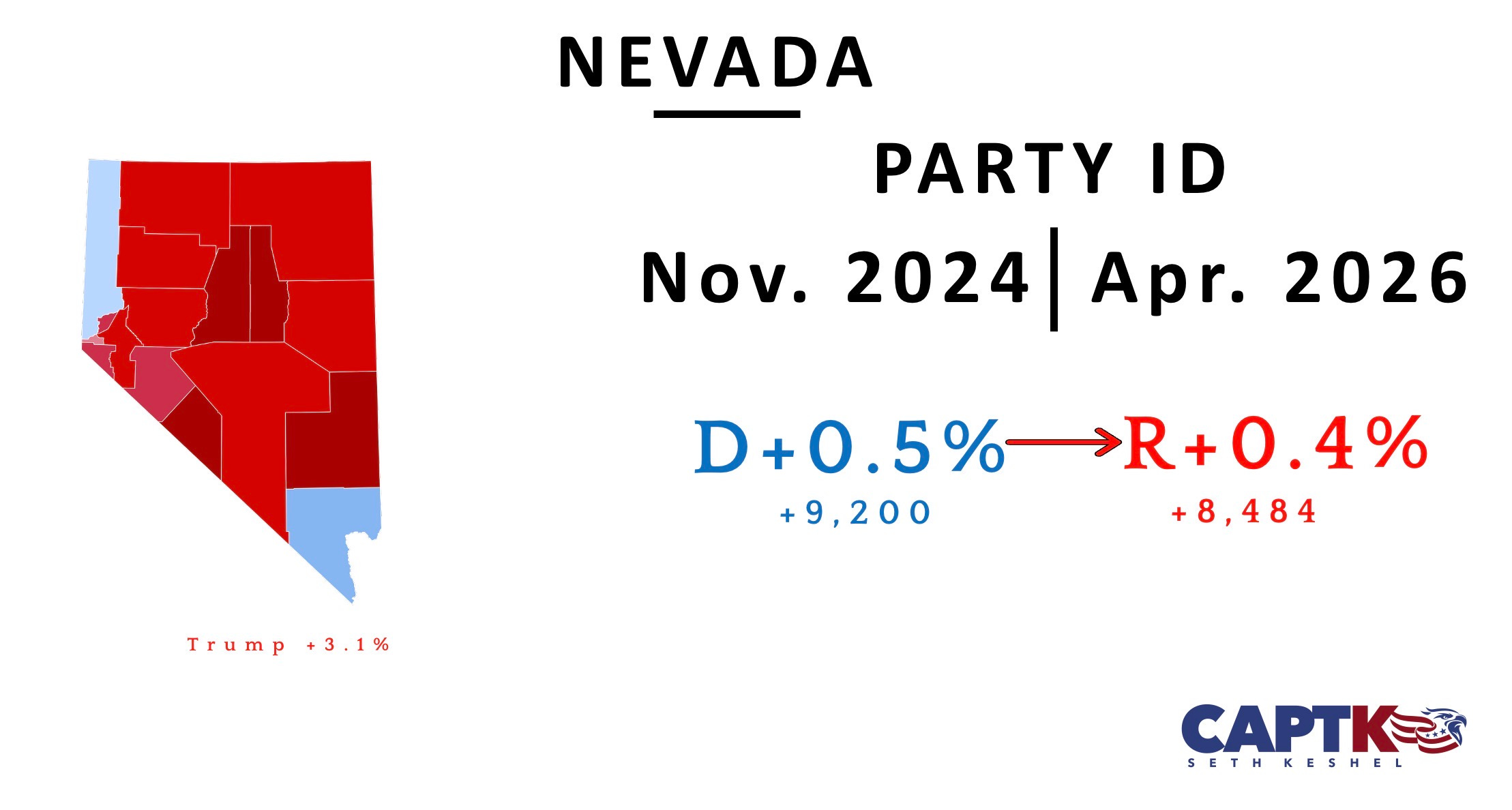
Net Shift Since March: N/A (not yet published by the state) - numbers above unofficial
Nevada has been a back-and-forth affair for months, with the GOP running up a nice cushion, but now about to relinquish it back perhaps as early as this month thanks to Democrat gains in Clark County; however, thanks to voter roll maintenance in Clark, the Republicans stand to make up 7,184 net registrations minimum statewide, pending data from the outlying counties. Miraculously, voter registration maintenance in urban counties seems to only hurt Democrats.
Nevada has its statewide offices up for grabs this year, plus at least one potentially competitive House seat. With over two-thirds of the statewide vote coming from Clark County, it is an obvious focus area for the GOP that must not be neglected.
Seth Keshel, MBA, is a former Army Captain of Military Intelligence and Afghanistan veteran. His analytical method of election forecasting and analytics is known worldwide, and he has been commended by President Donald J. Trump for his work in the field.
Do you track the Independent registrations as well?
🇺🇸
I find it shocking that half the country (or half of the ballots) still enthusiastically stands behind the Party of Marxist-Leninism & Fascism.
The Democrat Party hates white people, traditional family structure, free markets, free speech, a balanced budget, & our own energy industry.
And that's just for starters. They are on record in support of mutilating the genitals of children and will bring the country to it's knees to protect illegal alien murderers and rapists.
I don't understand my friends and family that still go to mass & get enraged & triggered at any mention of these facts? Perhaps liberalism truly is a mental disease & half the country is infected?
And The Democrat Party hates Christianity too. Happy Easter?
✝️