


I had breakfast this morning with Rachel as she was on her way to the Capitol for session, and she commented that the political life is always “go, go, go.” I told her the only way out of that was to get into bird watching or some other topic requiring less diligence and attention. Similarly, if you want to be less stressed out about the ins and outs of politics, you need to dedicate your focus to the long-term picture rather than the short-term one. The short-term outlook on politics leads to doom-and-gloom when you have setbacks like:
I have tried and tried and tried to inject reality into the unbridled optimism of those expecting Republicans to wipe the floor with Democrats this year, even when 20 of 23 midterms since 1934 have seen the President’s party lose seats. They either mistake my realistic outlook for negativity or go right back to the drawing board wanting to pump money and manpower into seats the Democrats will win by 25 points when they could drive change more effectively by focusing on 39 House seats, 5 Senate seats, and 4 gubernatorial races that are going to determine the balance of power in 9 months.
S2 Overview: 2026 Midterm Mission Briefing

Within a week, I will deliver a very important 60-90 minute presentation encompassing my full mission overview for the 2026 midterms:
If you’ve read this newsletter for any reasonable amount of time, you probably know that Democrats are getting trounced everywhere in voter registration since the 2024 election, save for Utah (voter roll cuts) and New York (NYC Primary last year). I am on high alert over a recent reversal of fortunes in Pennsylvania, which I will discuss at length if it continues, but for now, the Democrat outlook is bleak for the long run. Every time I promote these long-term trends, someone out there always goes:
If Republicans are gaining so much registration, why did they lose a seat Trump won by 20 in a special election?
Fair question. Voter registration by party analysis is dead-on accurate for presidential elections (and the disruption of those trends is one major reason I could tell the 2020 election was a fraud), but doesn’t always manifest in off-year, midterm, and special elections. You can read why in this piece:
Why Off-Year, Midterm, and Special Elections Suck + It’s Still the Mail-In Voting

Today is as good of a day as any to finalize discussion of the November 2025 elections and move into the entryway of what is certain to be another turbulent year in the political space with the 2026 midterms. Honestly, I’m thankful none of the major elections Tuesday were lost in legitimate red states or the Internet would be entirely unbearable right now, instead of just a minor nuisance.
Today’s article is going to examine three states - Florida, North Carolina, and Pennsylvania - which have all three had solid Republican registration gains going on since the 2010 election cycle without disruption. Florida’s dramatic shift has made it wholly uncompetitive in all statewide elections, while North Carolina may be headed that way as well (at least presidentially) if only their state could quit taking Democrats seriously at state level. Pennsylvania remains the ultimate battleground and is arguably now what Ohio was for decades as a national bellwether.
2010 Midterm Cycle
A national red wave environment featuring the emergence of the Tea Party and a tremendous repudiation of Barack Obama. Republicans took back the U.S. House, made major gains in the U.S. Senate, and picked off countless offices nationwide.
Florida
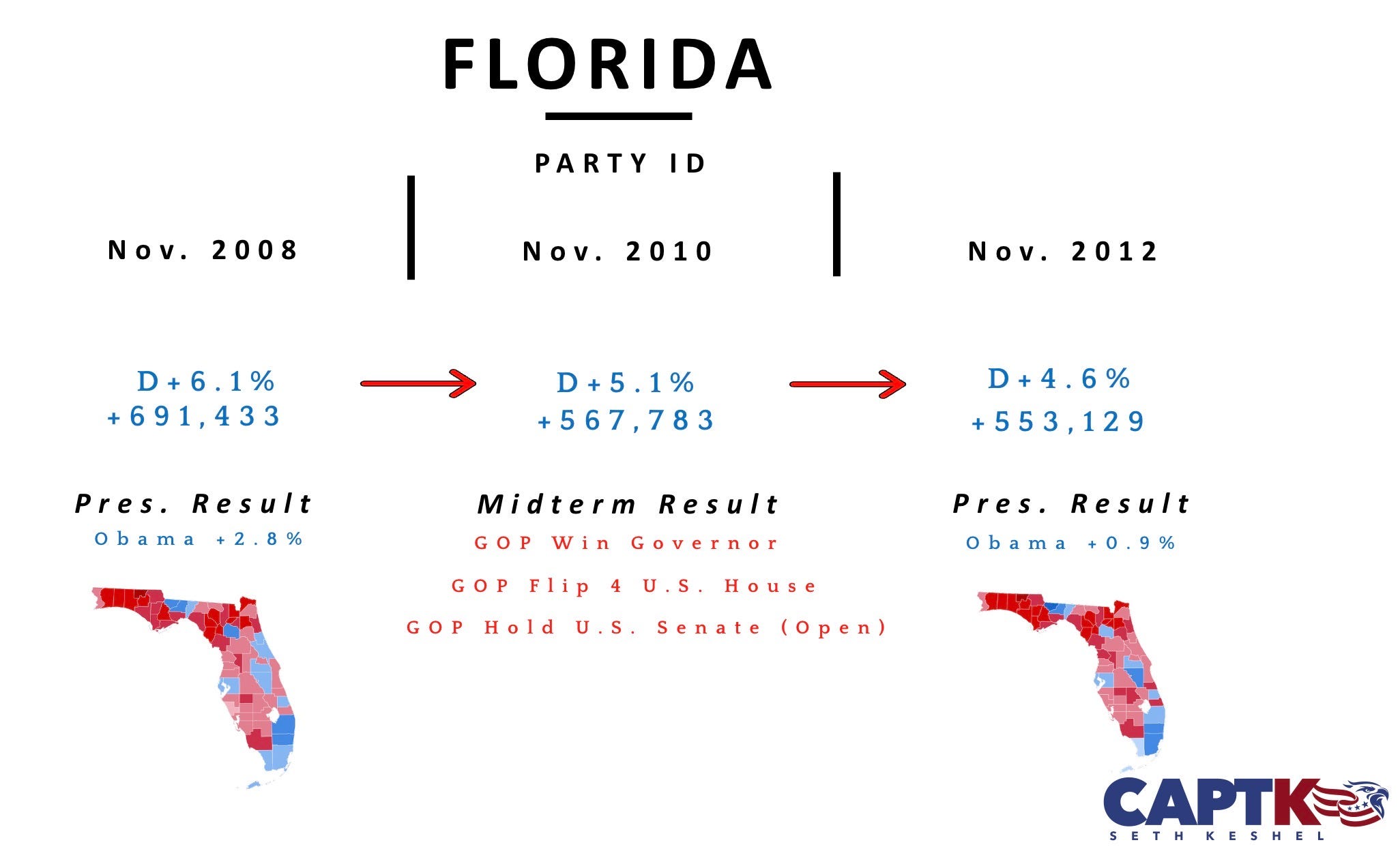
If you really want to ponder just how far we’ve come, remind yourself that Florida twice gave its electoral votes to Barack Obama. The registration shift toward Republicans began in the runup to the 2010 midterms, and the state had already moved 123,650 registrations to the right two years after Obama had won it for the first time. Rick Scott won the governorship (+1.2%), Republicans flipped four U.S. House seats, and Marco Rubio won an open Senate seat in a three-man race.
Party registration tracked with results in 2010 in a red wave. In 2012, in line with party registration shifts, Obama held on by less than a point against Mitt Romney before Trump would flip Florida for good four years later.
North Carolina
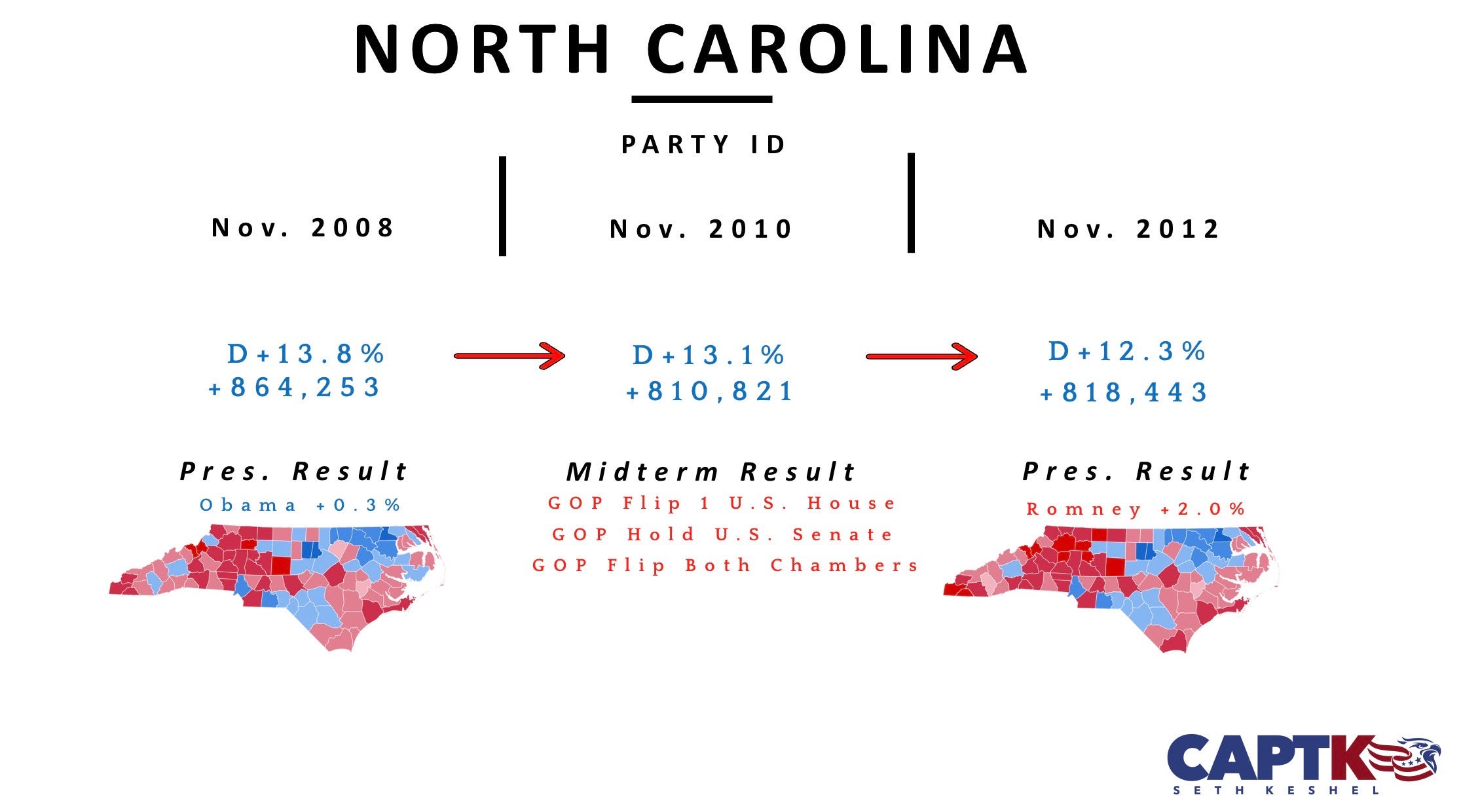
North Carolina qualifies as Obama’s second-biggest upset of 2008, just behind Indiana. It has always had an artificially high Democrat registration advantage that has only disappeared as recently as last month for the first time in history, but the erosion took 17 years from Obama’s high point. By 2010, the state had moved 53,432 to the right, signaling a flip of one U.S. House seat, a hold of Richard Burr’s Senate seat (+11.8%), and Republicans taking over both chambers of the state legislature. The gubernatorial race in North Carolina runs concurrent with presidential elections.
Pennsylvania
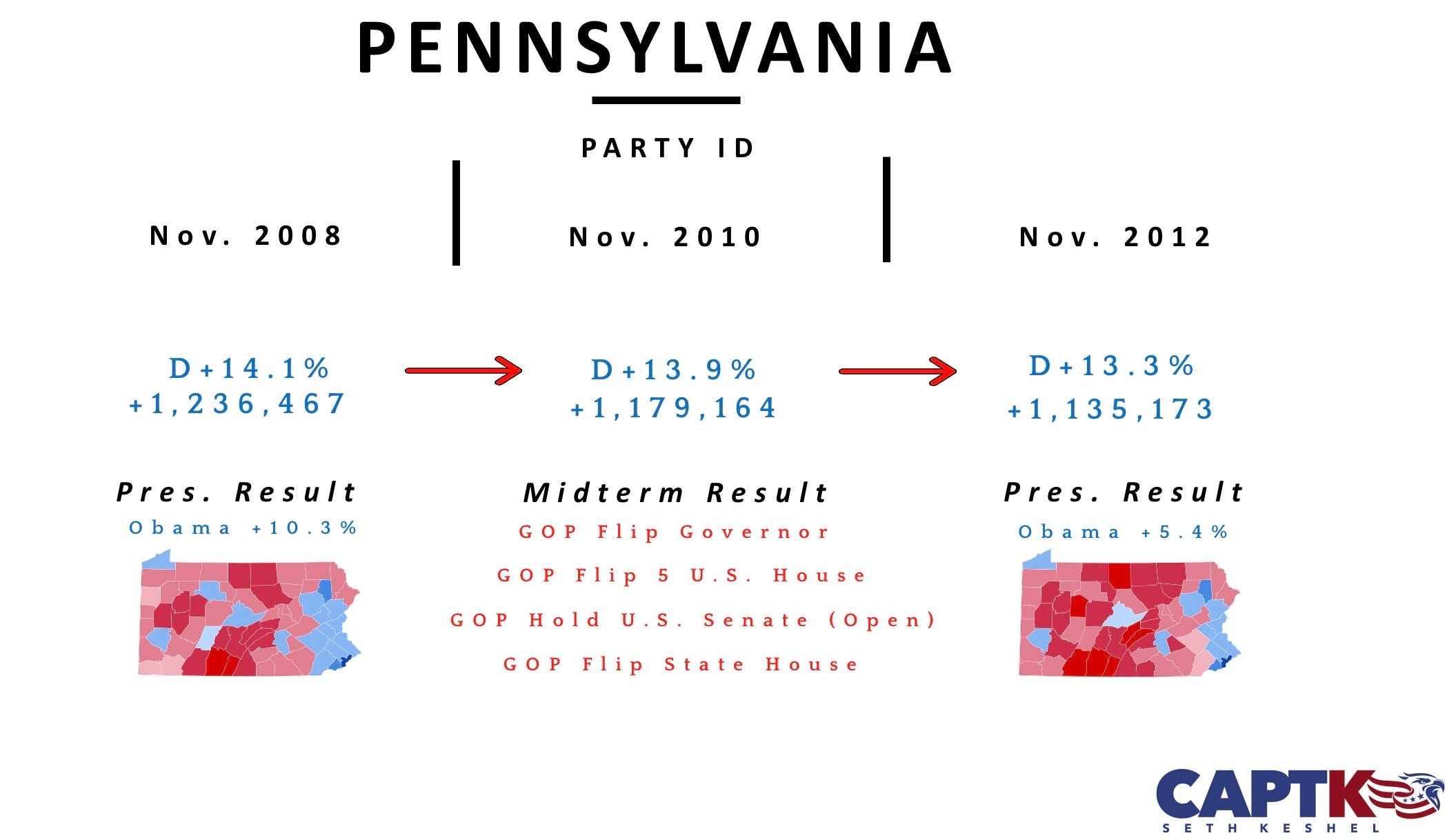
2008 also represented a modern Democrat high point, with Obama carrying the state in the largest landslide since 1964’s Johnson blowout, sitting on a registration advantage in excess of 1.2 million. With no blue collar standard bearer present, the Democrat advantage eroded gradually. The GOP gain had been just 57,303 by the 2010 midterms, but Republicans flipped the governorship and five U.S. House Seats, and held an open Senate seat with Pat Toomey as nominee. They also flipped the state House of Representatives.
In all three sample states, party registration tracked with Republican gains.
2018 Midterm Cycle