



Introduction: Phani Mandtravadi, co-founder of CheckMyVote.Org and an incredibly important voice for national elections (including in his home state of Michigan), has authored today’s post as both a review of my new book and to highlight how my method of evaluating data at the precinct level aligns with his, although both were developed individually. Links to view Phani’s work are distributed throughout this piece.
Importantly, Phani recently obtained his United States citizenship. Please join me in congratulating him on this momentous achievement.
Seth Keshel’s book, The American War On Election Corruption: The Crusade To Restore Trust In Voting, bears testament to the enduring truth that Almighty God has given each of us unique talents and a purpose in this world. It is incumbent upon us to recognize those talents and apply them in fulfillment of His will.
Seth’s journey begins with baseball, an unlikely but fitting backdrop for the development of his passion for data analytics and statistics. He recounts how he applied his analytical skills to predict baseball outcomes, demonstrating an uncommon ability to identify patterns within large, discrete datasets and translate those patterns into real-world insight. This is a rare and valuable skill. Yet, as he describes, his knowledge was often dismissed by peers as “useless.”
Despite moments of discouragement, Seth never abandoned his passion. He continued refining his abilities, remaining steadfast in the face of skepticism and lack of encouragement. What others dismissed as “useless” ultimately proved to be anything but. His story is a powerful illustration of a timeless principle: success occurs when preparation meets opportunity.
For Seth, that opportunity emerged in the realm of political data.
The playing field shifted from baseball diamonds to election maps. The players were no longer pitchers and batters, but candidates and voters. As Seth began analyzing political data, particularly in comparison to mainstream polling—he observed a growing disconnect between reported narratives and observable data trends. This realization marked the beginning of a deeper exploration into demographic shifts and electoral outcomes across the United States.
Through this book, Seth brings together a wealth of discrete and relevant information, using historical precinct-level election data spanning decades to identify patterns and predict outcomes. He explains, in clear and accessible terms, how demographic changes across America often appear inconsistent with organic trends. The data suggests the possibility of external forces influencing voter records and election results.
What sets Seth apart is his ability to translate complex data into compelling and understandable narratives, an ability that is both impressive and urgently needed.
Convergence of Seth’s and CMV’s analysis
When I first became involved in election integrity work in early 2021, I relied heavily on what became known as “Keshel Heat Maps” to guide my own analysis of voter rolls. While Seth’s methodology focuses on precinct-level results and anomalous voting shifts, my work through CheckMyVote.org centers on voter roll data itself. These are fundamentally different approaches.
And yet, they converge.
(Link to CheckMyVote Substack above)
These factors include:
Potential duplicate registrations
Registrations tied to empty lots
Registrations from apartments or hotels without unit numbers
Registrations associated with individuals aged 90+
Registrations from individuals who have moved out of state (excluding military)
Registrations with registration years prior to 1942
Registrations linked to UPS/USPS locations
Registrations associated with prisons
These variables are aggregated and normalized into a score between 0 and 10, providing a relative measure of voter roll integrity across jurisdictions.
In 2024, after grassroots volunteers began asking how our scoring compared to Seth’s heat maps, Seth and I decided to directly compare our findings. At the time, Seth had just completed a fraud heat map for Dickinson County, Michigan.
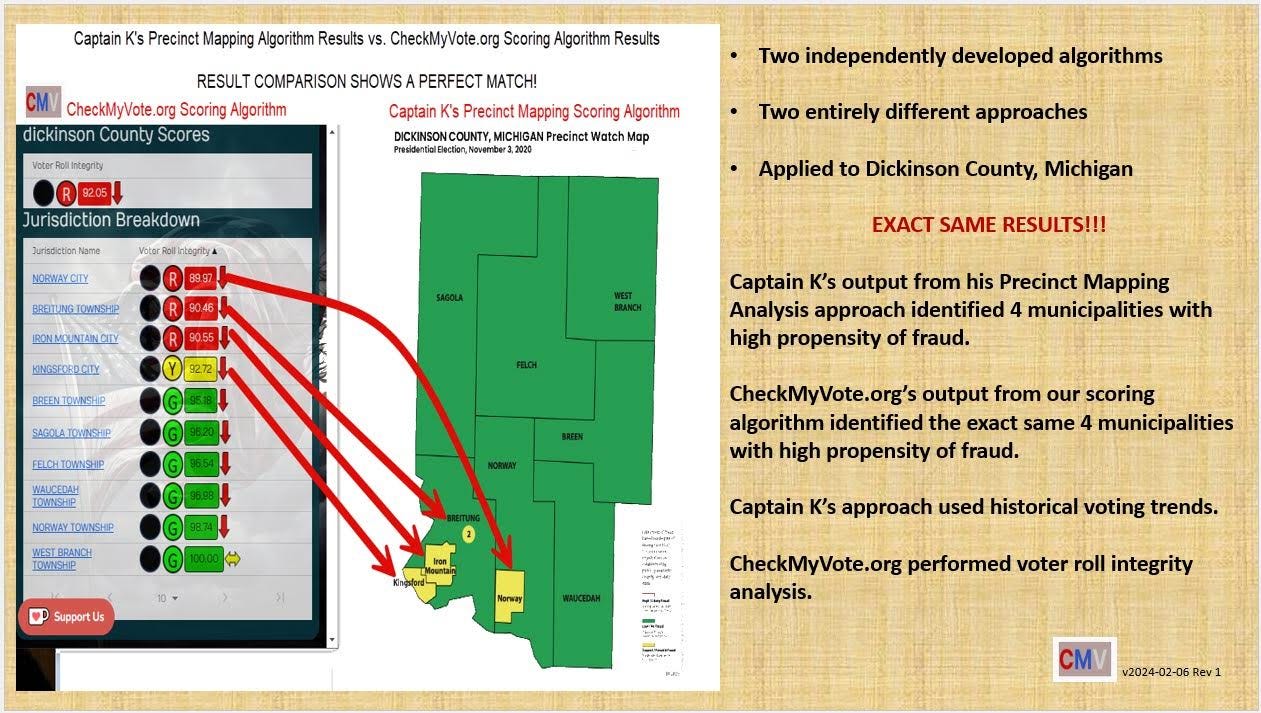
What we discovered was remarkable.
Despite being developed independently and based on entirely different data sources and methodologies, our results aligned almost perfectly.
This convergence is not a coincidence. It reinforces the growing concern that election anomalies are not isolated artifacts of any single dataset or analytical method. Rather, they are patterns that emerge consistently across independent analyses.
Why This Matters
The alignment between Seth’s precinct-based analysis and CheckMyVote’s voter roll analysis lends significant credibility to the broader concern that systemic issues may exist within our election systems.
This is not about speculation.
It is about data.
It is about patterns.
And it is about the responsibility to investigate those patterns lawfully, transparently, and rigorously.
Conclusion
Seth Keshel’s The American War On Election Corruption exposes a critical gap between observable reality and the narratives often presented by mainstream institutions and media. It challenges readers to think critically, examine the data for themselves, and engage in the preservation of our electoral system.
This book is a must-read for every American.
It is essential reading for those who believe elections are functioning perfectly—and equally essential for those who already recognize that systemic vulnerabilities may exist.
The integrity of our elections is foundational to the survival of our nation and the future of our families. If corruption exists, it must be addressed lawfully and transparently. If it does not, transparency will confirm that.
Either way, the truth must be pursued.
Seth’s work represents a significant contribution to that pursuit.
Seth Keshel, MBA, is a former Army Captain of Military Intelligence and Afghanistan veteran. His analytical method of election forecasting and analytics is known worldwide, and he has been commended by President Donald J. Trump for his work in the field.

Thank you Seth, I consider it a great honor to be recognized and congratulated by you. o7!
Congratulations to Phani Mandtravadi on becoming a citizen of the USA and applying your skill set to a HUGE problem we intend to solve.
Thank you for co-founding, CheckMyVote.org . There are millions of Americans who take action based on such research.
And thank you also for collaborating with Seth Keshel to add further proof that you both are correct and our elections have been and are being stolen.
Time to end Election Theft.