


Author’s Note: For a summary of why voter registration by party is so important, and to understand the importance of these states and why each were selected for this recurring study, please see the March 2025 summary.
Last month’s report can be found here.
FLORIDA
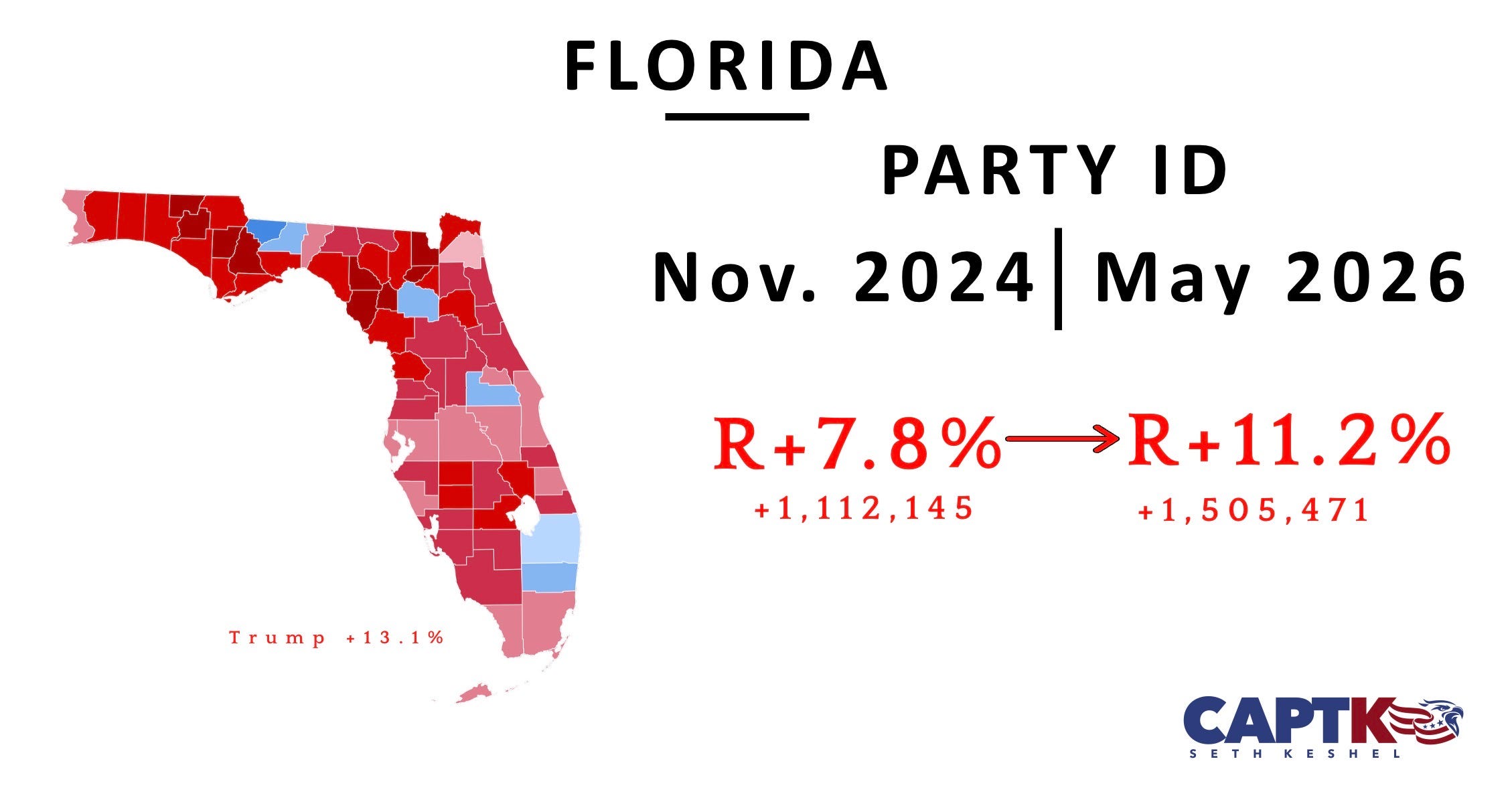
Net Shift Since April: R+6,731
Republicans made yet another gain, and one larger than March’s. The overall registration advantage for the Republican Party, thanks to this boost, is now over 1.5 million and expanding by the day. Incredibly, despite Florida’s growth and an approaching primary, Democrats lost 2,257 net registrations.
Florida’s drift is predictive for Pennsylvania and Michigan since 1952, portending good things for future GOP campaigns in both of those battlegrounds in the next presidential election. At this point, Florida appears to be emerging as the premier GOP superstate, passing Texas (although not in order of importance by electoral votes and House seats).
IOWA
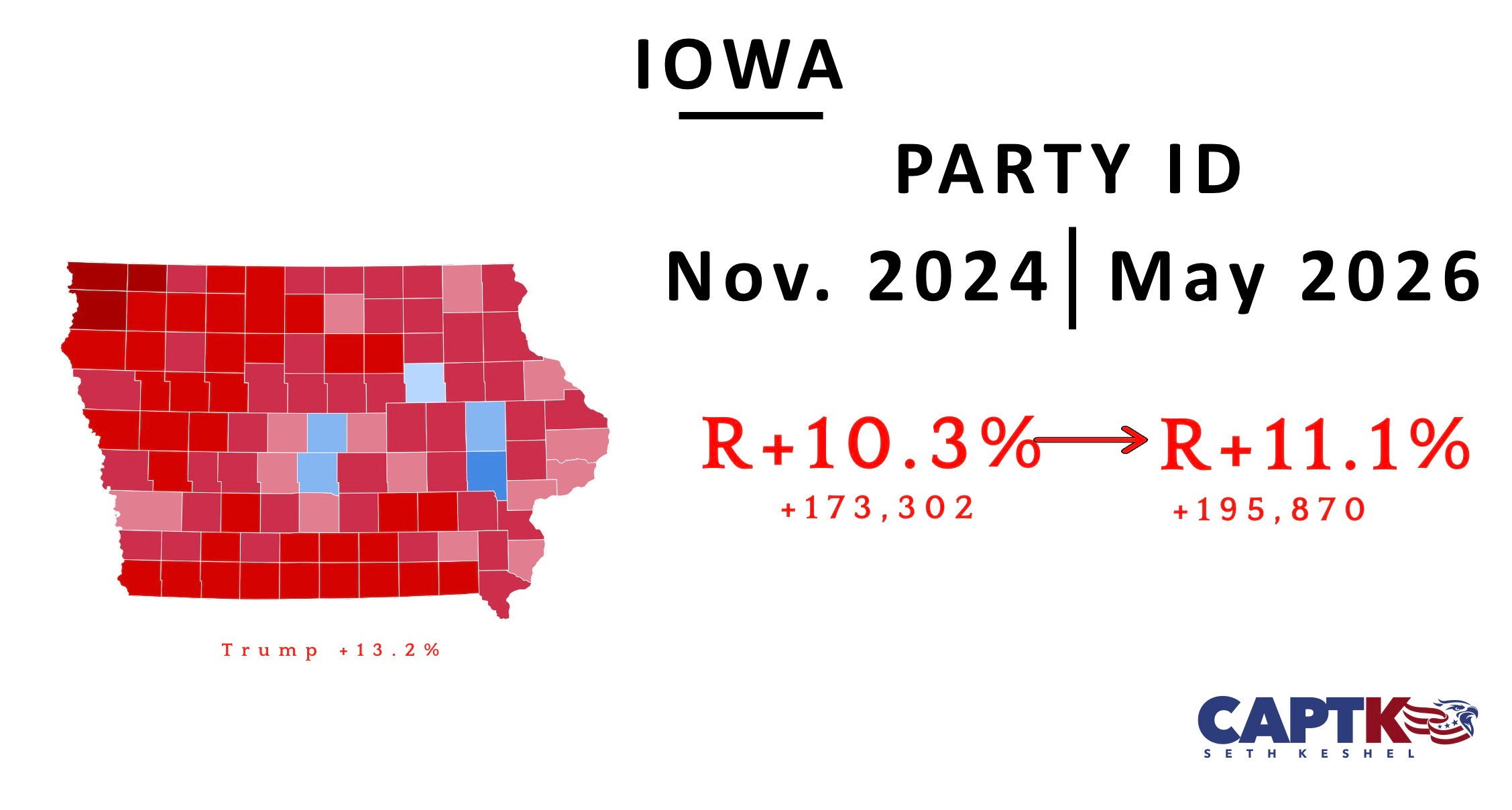
Net Shift Since April: D+2,727
This is the first technical Democrat net gain in raw numbers since I’ve been tracking these numbers in monthly reports after the 2024 election; however, it is purely a product of voter roll cuts. Both major parties lost registrations in massive numbers, and the overall roll shrank by more than 20,000. Because of this, the GOP advantage by percentage increased from R+10.9% to R+11.1%.
Iowa has two competitive U.S. House races this year; most importantly, the state tracks with Wisconsin and Minnesota as a proxy, given that those two states don’t register voters by party.
PENNSYLVANIA
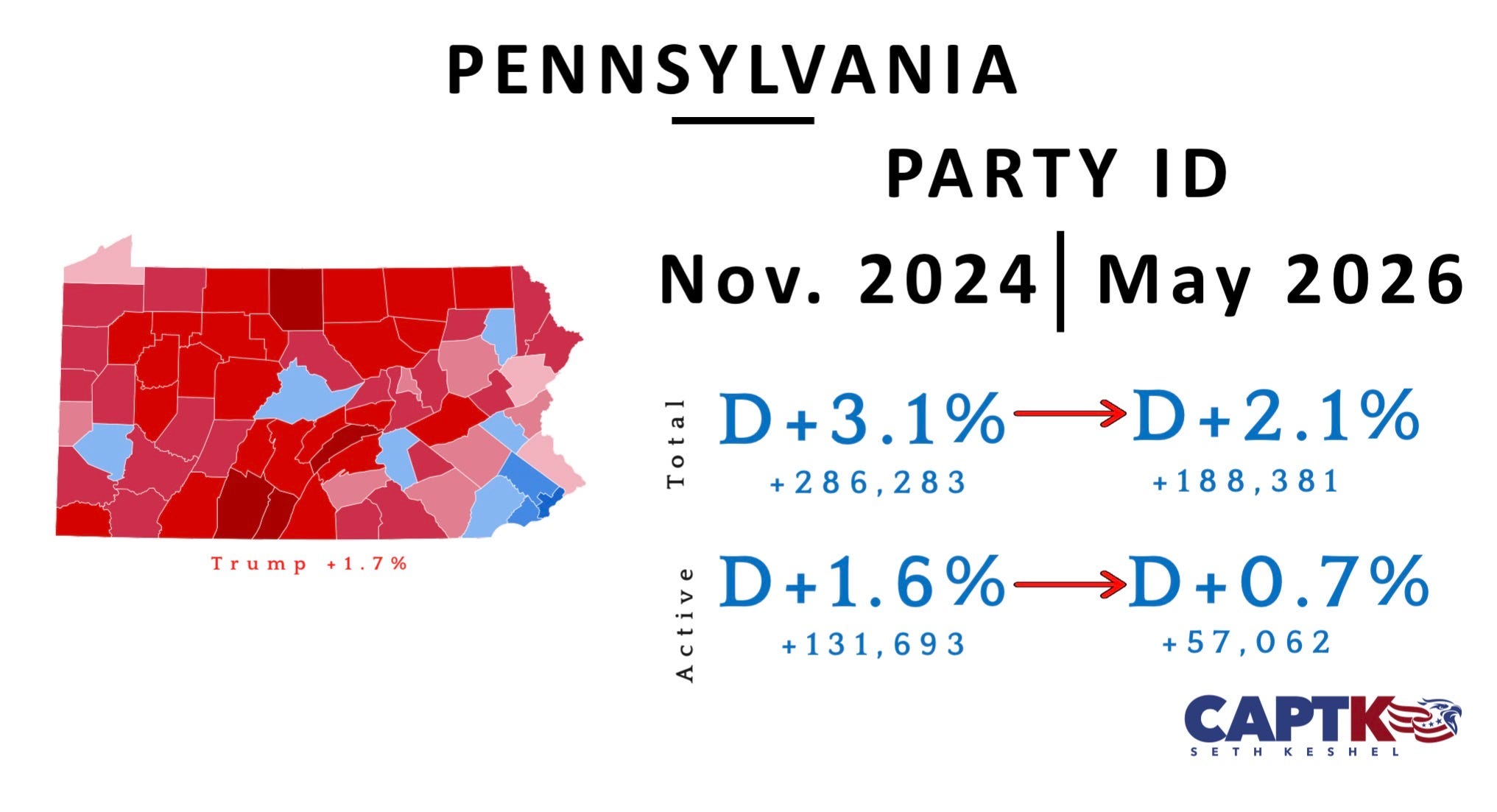
Net Shift Since April: D+9,604 Total, D+10,345 Active
If you thought things looked bad last month, then you’ll want to gloss right over this summary on the Keystone State. Ahead of the May 19 primary, Democrats padded their active voter registration lead by over 10,000.
Just as I explained last month, these numbers do not make sense based on registration trends elsewhere, even in places where Democrats are making temporary gains. In fact, I see no possibility that Oregon should be making Republican gains (it is) but Pennsylvania would be having a genuine change of course unrelated to an approaching election. Most of this shift appears to be Philadelphia-centric, and validating my point is the fact that Erie County has shifted Republican in the last quarter (since the February update), and Northampton County is generally treading water. There does not appear to be a legitimate coalition shift away from MAGA in Pennsylvania with the working-class voter.
Democrats have still lost a ton of their dwindling advantage since the November 2024 election, and it is possible Pennsylvania is the new Ohio - a true national bellwether with an elastic independent voter base.
NORTH CAROLINA
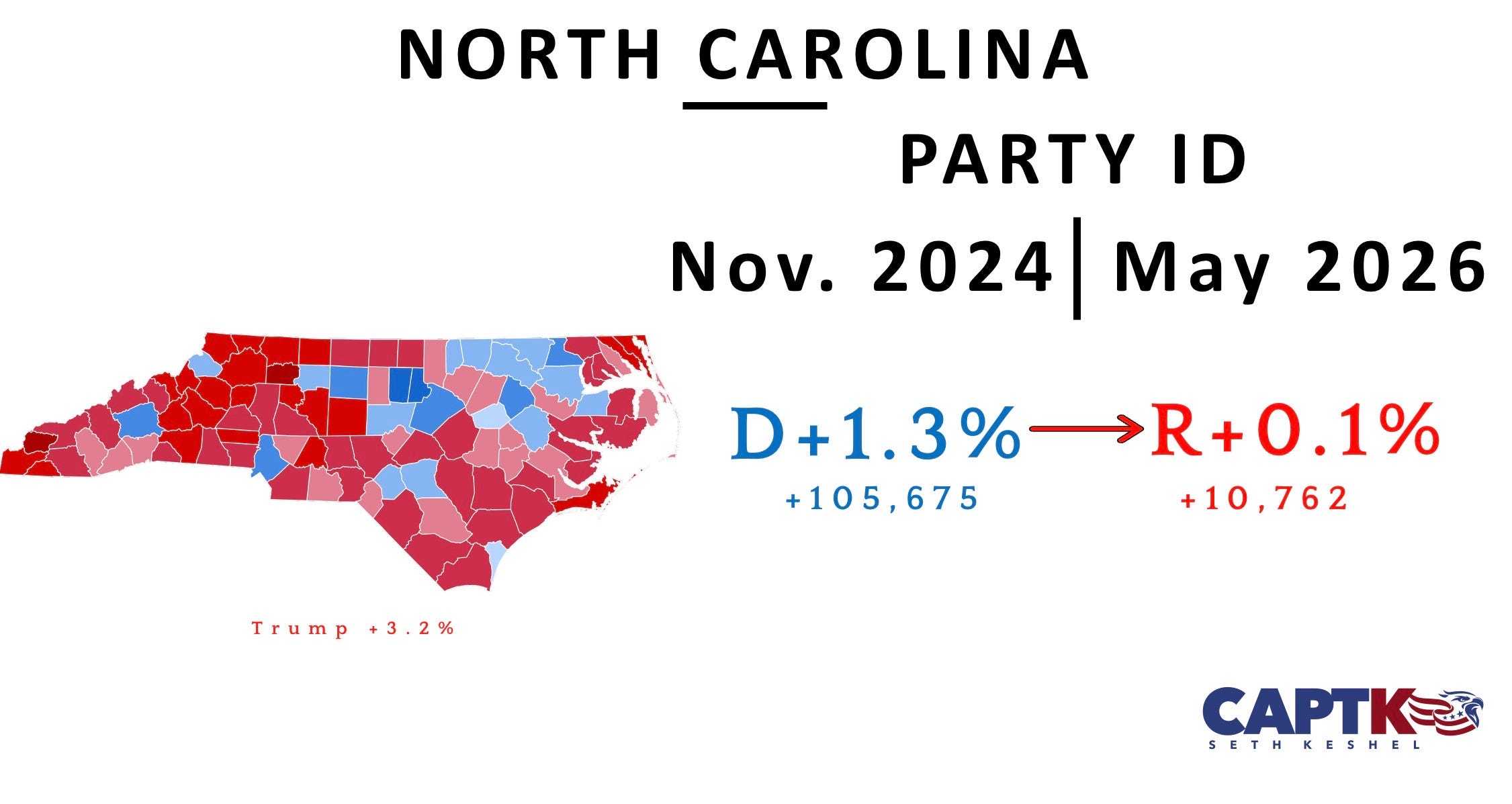
Net Shift Since April: R+702
The North Carolina GOP made a narrow gain in the overall voter registration lead, while stepping slightly backward in active registrations as voter roll maintenance takes place. The overall lead is now 116,437 to the right of the former GOP deficit at the time of the November 2024 election.
With former Democrat Governor Roy Cooper running for U.S. Senate, Republicans need all the help they can get. I consider the GOP-held seat in North Carolina the most likely to flip to Democrats in 2026, with Michael Whatley the Republican nominee.
NEW HAMPSHIRE
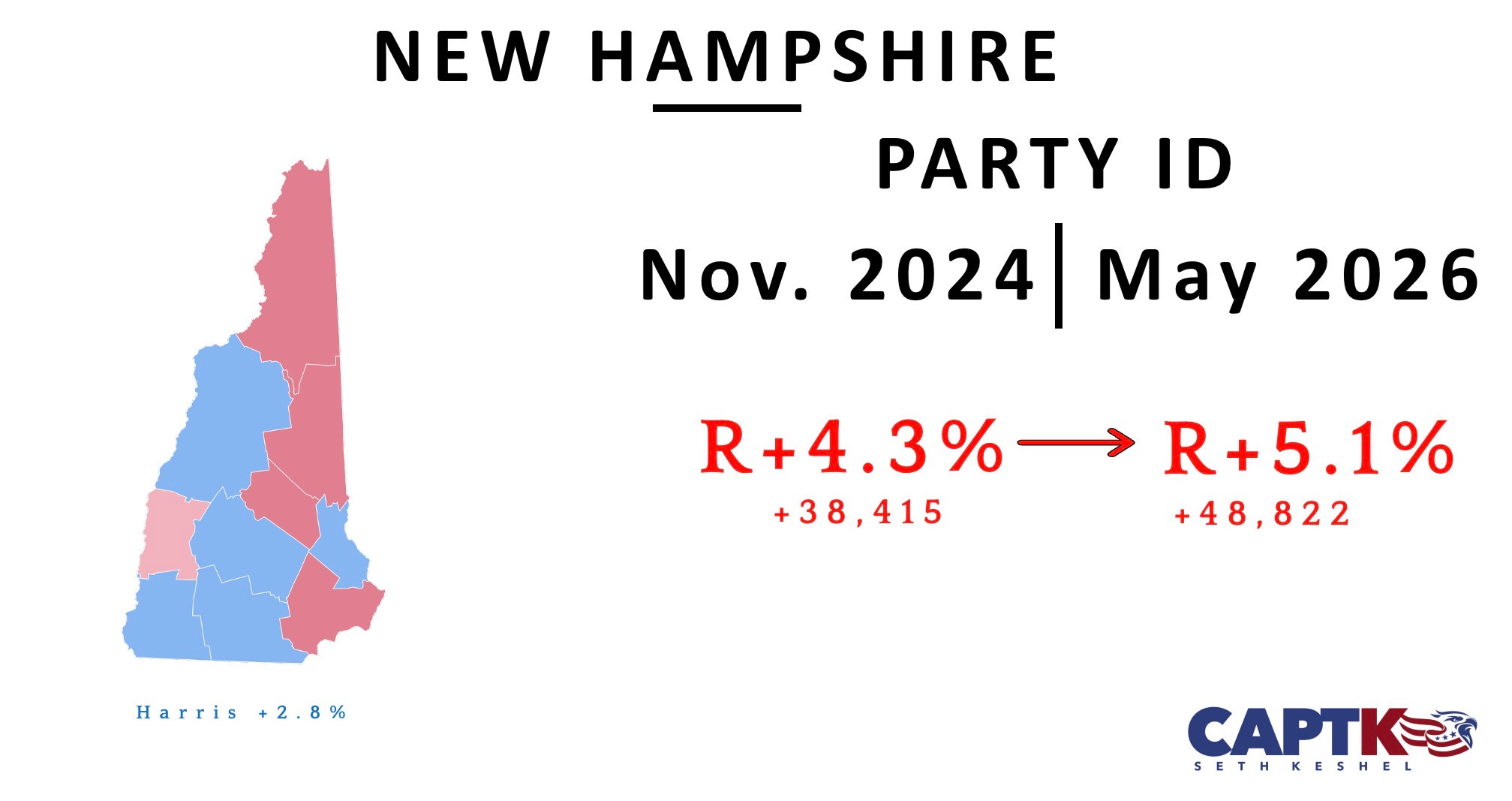
Net Shift Since April: D+450
New Hampshire releases quarterly updates, and in the first update since February, Democrats gained a net of 450 due strictly to voter roll maintenance. Both parties lost membership and the overall voter roll decreased narrowly. I expect to see a lot more volatility in the next update as the state gets ready for primaries later this summer.
The Granite State remains the most likely Republican flip for the 2028 presidential election, and has several important races on the ballot in 2026, like a U.S. Senate seat and the battle for NH-1, which Democrat Chris Pappas will vacate to run for said Senate seat.
ARIZONA
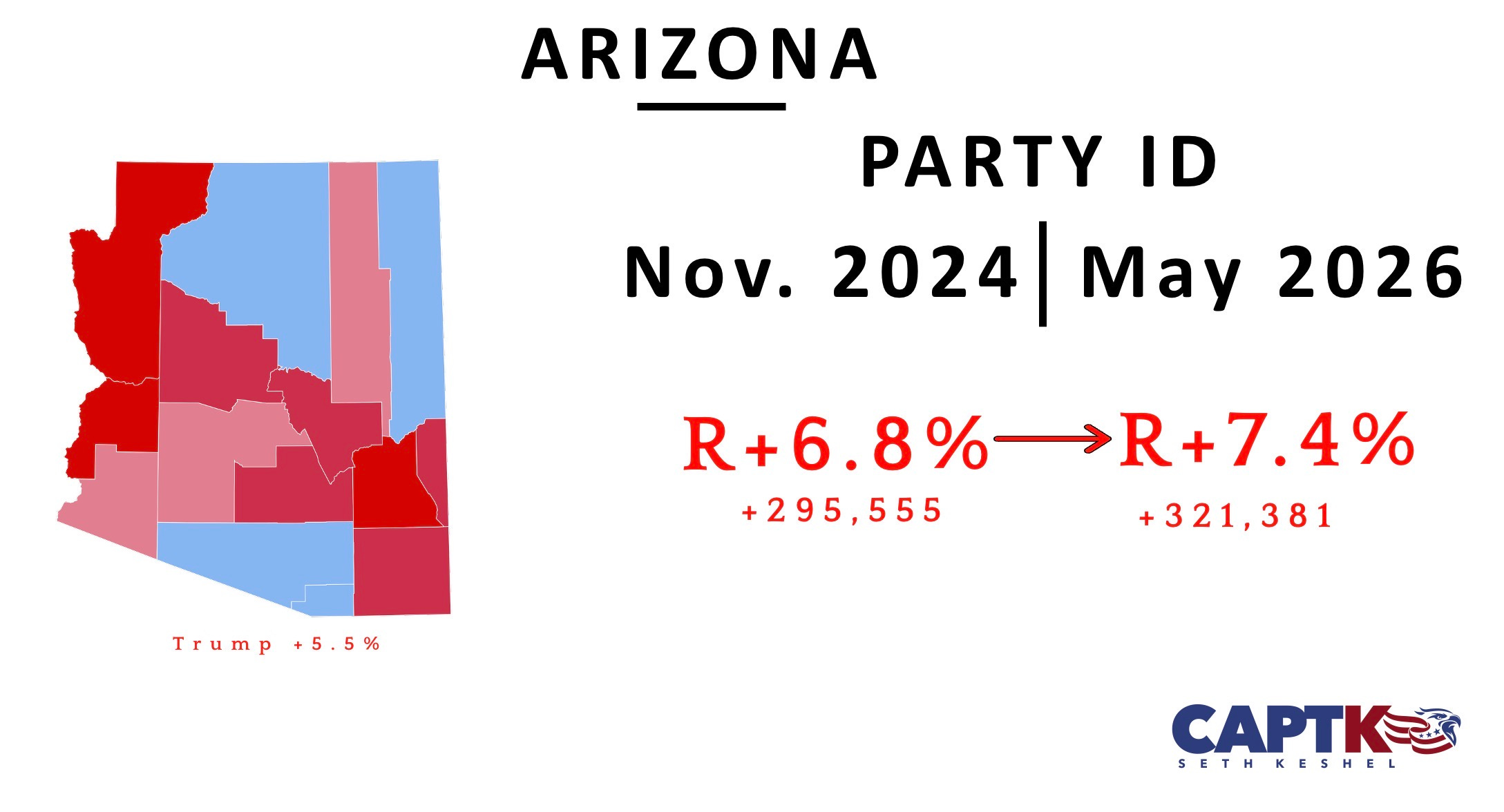
Net Shift Since April: D+2,886
The Secretary of State published the occasional update for all 15 counties last month, which holds the data I am supplying in this report and will continue to provide when available rather than adjusting on the fly to data from the two counties I can actively monitor for an unofficial count. Those two counties, Maricopa and Pima, are responsible for most of the Democrat gains in recent months. My analysis of the Maricopa County legislative districts suggests serious money and effort is being expended to amp up voter registration numbers in mostly blue districts.
The next update for Arizona will likely drop in July, making it in time for the August report.
Expect Democrats to pull out all the stops to save Katie Hobbs and her cohort of corrupt statewide officers this fall.
NEVADA
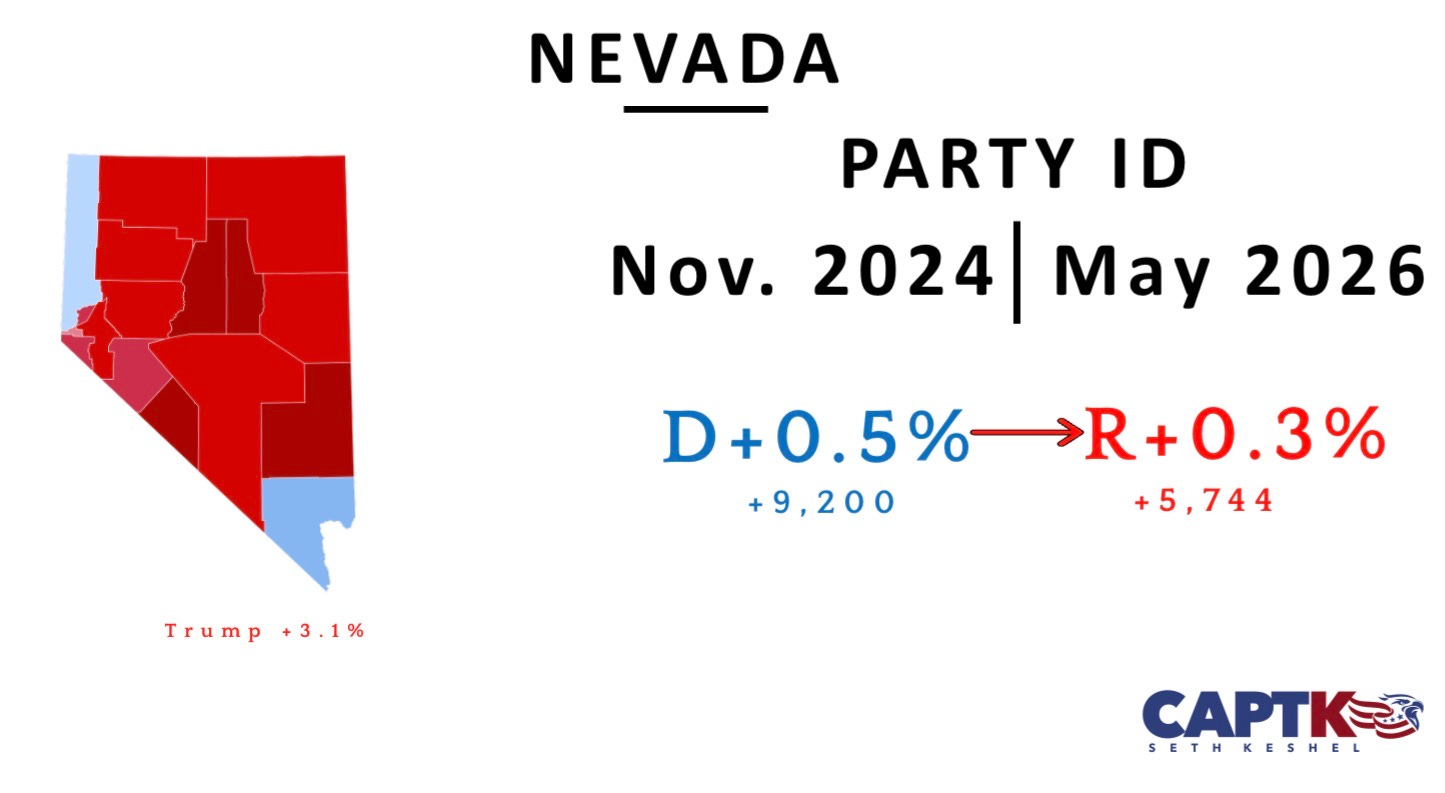
Net Shift Since April: D+1,474
Nevada shifted back nicely for Democrats in April, although almost all of this gain is attributable to their efforts in Clark County (Las Vegas metro) ahead of the June 9 primary. Republicans continue to deepen their advantages throughout the crimson interior of the state post-maintenance.
Nevada has its statewide offices up for grabs this year, plus at least one potentially competitive House seat. With over two-thirds of the statewide vote coming from Clark County, it is an obvious focus area for the GOP that must not be neglected.
The American War on Election Corruption, my bestseller, is now approaching 10,000 units sold. Please consider buying a copy for yourself or those who need to be persuaded that election reform is an issue of national survival today.
Seth Keshel, MBA, a former Army Captain of Military Intelligence and Afghanistan veteran, is the author of The American War on Election Corruption. His analytical method of election forecasting and analytics is known worldwide, and he has been commended by President Donald J. Trump for his work in the field.
Regarding Pennsylvania, keep in mind that the Primary is May 19, and in Philadelphia for sure, and maybe a few other counties, it is almost impossible to elect Republicans for local government positions in a general election, so as the Primary approaches some people will register as Democrat in order to vote in the Democrat primary for their preferred candidate for city or county positions. Possibly this is affecting the registration numbers in Philadelphia.
I think a successful resolution to the war with Iran is key to GOP hopes in New Hampshire. For Nevada, we need to do more Federalization of the California oil infrastructure (refineries and pipelines) to help lower gas prices in Nevada. Most people don't realize how much of prisoner Nevada is to California's crazy energy policies, but it is. If we can provide relief at the pump in Nevada, that would help across all of the key demographics that Republicans need to win to do well in the State.