


I guess, now that the Taliban operates it, I can tell you about the old days at Shindand Air Base without fear of compromising sensitive information and winding up under the jail somewhere. Shindand was an old Soviet airfield left to rot until coalition forces decided to operate out of it in the early days of post-9/11 conflict in Afghanistan.
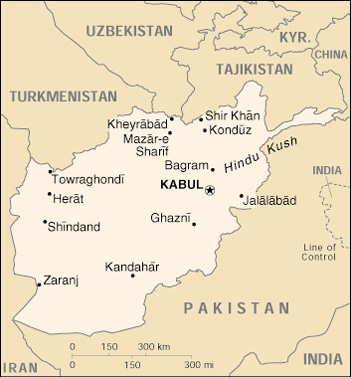
In the map above, you can see Shindand in the far west, up against the Iranian border. It lies at the far southern end of Herat Province and in the 2010-11 surge, which took place during my time in-country, it wasn’t engulfed in kinetic activity (constant chaos and fighting). The area was a trafficking corridor for arms and personnel coming in and out of Iran. Our aviation task force, Task Force Comanche, operated out of Shindand Air Base. See the primitive conditions below:
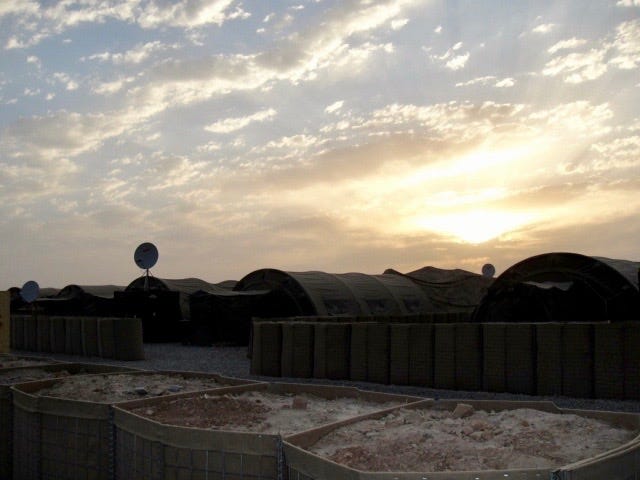
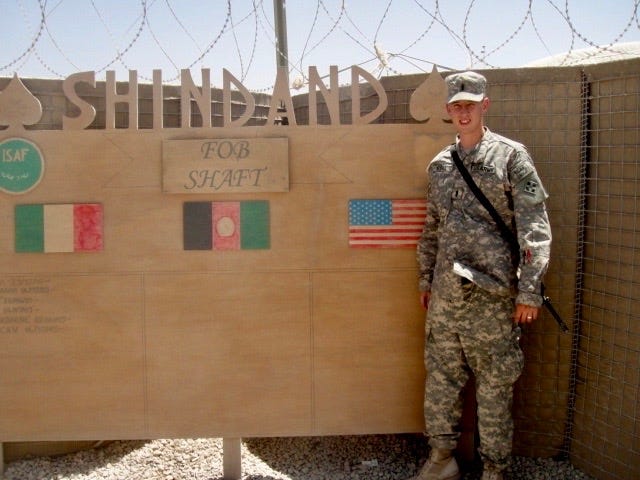
We took the occasional rocket attack (which stopped once my intel section pegged the timing pattern and the insurgent responsible had his arms blown off), but most fighting was to our south in Helmand Province, where the Marines and British duked it out, or to our north in Badghis Province. You can read about some of these combat stories in The American War on Election Corruption if you are interested.
When we arrived in June 2010, we took over from an American unit called Task Force Ready, based out of Germany. The sleeping tents were primitive, with limited cooling capability, showers were makeshift, and very few hard buildings were available to house operations staff. Our operations center was in the air tower, and we were piled on top of one another trying to make things happen day in and day out. Perimeter security was weak. There were jersey barriers here and there to stop rockets and vehicles, and HESCO baskets holding mounds of dirt to stop bullets and, when placed in a line, incursions on the base itself. A smattering of fencing and barbed wire was all we had to protect a military base with a huge perimeter surpassing that of many American airports in size.
For most of my tour, I straddled the day-night shift. I was proficient enough to be on the lead shift, even when I had a captain over me (I was a First Lieutenant during the tour), but my intelligence summary (INTSUM) was my bread and butter, and it went out at the stroke of midnight as the most widely disseminated of its kind in Regional Command-West. I would immerse myself in the intelligence reporting every evening as I built the INTSUM, and a constant threat appeared dozens of times as the months passed by:
SPECTACULAR ATTACK BEING PLANNED ON SHINDAND AIR BASE, OVER 500 INSURGENTS, HEAVY MACHINE GUNS, ROCKET-PROPELLED GRENADES, AND SUICIDE VEHICLE-BORNE IEDS.
I took this reporting seriously, because in 2009, Combat Outpost Keating had been overrun by a massive Taliban force in similar fashion. They had used terrain to overwhelm Americans on the base and temporarily seized it, before being run off. The base was subsequently destroyed by American troops after all the damage and death. Watch the movie The Outpost to see how horrific this type of attack is.
I pressed my commander, who took the threat seriously because he trusted me, to lobby the generals in charge to fortify Shindand Air Base. Months went by with excuses like, “We are hiring more Afghans to stand guard” taking the place of action (as if Afghans are who I want watching my back, anyway). I became so frustrated that one night I sat down to craft a master PowerPoint deck filled with maps and graphics highlighting the deficiencies in our security and called it “If I Were the Taliban…”.
Within weeks, millions were invested in the security of Shindand Air Base, and with no soft target remaining, a spectacular attack never occurred.
I had planned to attend Charlie Kirk’s memorial service in Glendale, Arizona, on September 21, 2025. Rachel and I drove up from Tucson and on the way, it became clear that we had a bit of a SNAFU. Rachel had not checked a box on her legislative ticket form for a “plus one” (me), and despite knowing tons of higher-ups at TPUSA and the state senator handling the legislators attending, couldn’t get me into the building. Yes, me. Seth Keshel, commended by the President of the United States, author, and husband of an Arizona representative. The combination of Secret Service, federal and state law enforcement agencies, and private security would not bend the rules.
Why?
Because too many important people were in that building, including the President and Vice President of the United States, to make any exceptions. You make an exception for me, then you make an exception for the next guy, and the next, and the next, all the way until you have a gap in security. The moral of the story is that in security operations, the enemy seeks to exploit any vulnerability he can find to attack his target(s).
Which brings me to the present moment…
Saturday night’s White House Correspondents’ Dinner at the Washington Hilton.
Cole Allen, 31, deranged libtard from California, ran right through a security perimeter staffed by Secret Service agents. While he was caught before he could reach the guests and begin shooting at a target-rich environment - what if he’d have breached the next ring of security as he did the first? We can call this a success all we damn well want to, but I think it boils down more to dumb luck or even Divine protection.