



Reader Note: For July 4th, I am sharing this essay by Wim Vanraes, a Belgian-born naturalized American writer whose historical analysis I have followed and used before, and whose work on America’s Christian inheritance deserves attention.
This guest article points toward two companion works also appearing today: Tending the Fire, a full pamphlet, and This We Declare, a shorter declaration. Together, they ask and explain in what sense America can rightly be called a Christian Nation, what that does not mean, and why Europe should care too.
This is not an argument for theocracy or political possession. It is an argument about inheritance, ordered liberty, and the moral architecture beneath the American founding.
Read this first, then follow it into the pamphlet and declaration. Happy 4th!
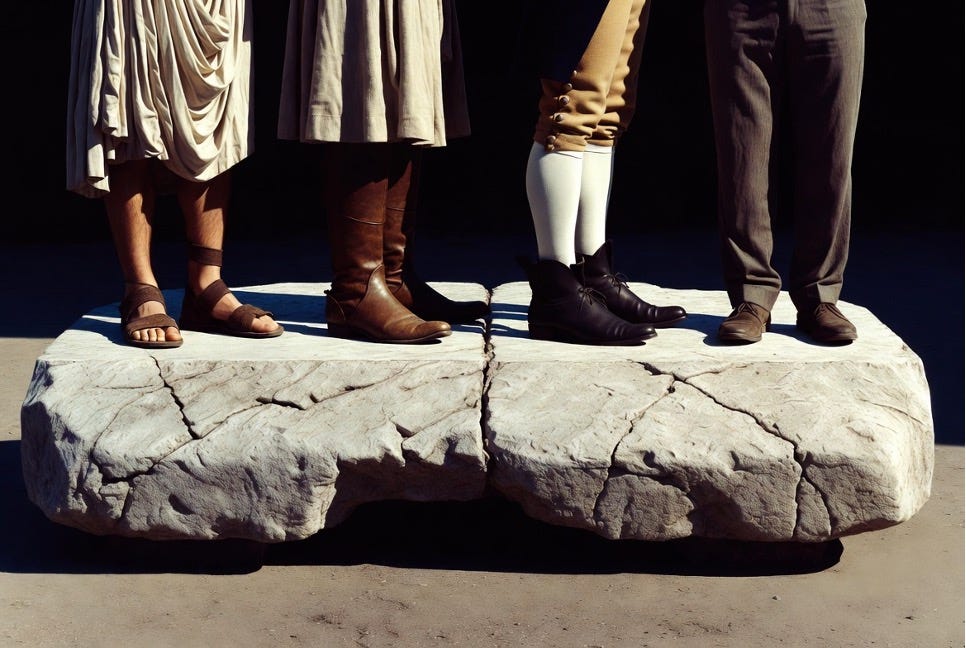
We are told, on the eve of the 250th anniversary of the founding of the United States of America, that we are the most divided we have ever been.
That, however, is not quite true.
The Civil War period saw two armed governments fight each other, brother against brother, killing hundreds of thousands. The freeman-slave divide, Reconstruction, the 1850s, the 1930s labor and radical conflicts, and the 1960s assassinations, riots, Vietnam protests, and urban unrest all ran hotter and bloodier than this.
So set the slogan aside and admit the truer, stranger thing: we are not the most violently divided we have ever been, but we may be among the most fundamentally divided. The shared world inside which Americans used to argue has come apart. That is what we need to pay attention to.
A free people is supposed to disagree, and America was built for disagreement. But disagreement used to happen inside something held in common: a frame of natural rights, ordered liberty, local self-government, federalism, conscience, law, civic virtue, public reason, inherited institutions, and enough shared moral grammar to make the argument intelligible to both sides.
Today, many of our disputes are no longer simply over which policy best serves the common good. They are over whether there even is a common good, whether the nation is legitimate, whether what we inherited is gift or guilt, whether liberty means self-government or mere self-expression, whether equality means equal dignity or enforced sameness, whether citizenship is moral membership or administrative status.
That is not ordinary political disagreement. That is disagreement about the framework within which political disagreement is supposed to occur. And this fracture does not neatly follow party lines, either, even if that represents a major gap. Ask any conservative this simple question: what is it that needs to be conserved? You will end up with many good but incomplete and different answers.
The border. The unborn. The Second Amendment. The family. Free speech. The Constitution. The nation. Markets. Faith. Local communities. Western civilization. Law and order. School choice. Energy independence. Peace abroad. Strength abroad.
All of these may be good. Many are indeed necessary. But a bundle of positions is not a civilization. A bundle can coordinate temporary resistance, but it cannot hold a people together, because the moment the common enemy is gone, it falls back into its quarreling parts.
So what if the problem is not that this coalition refuses to cohere, but that a body of many parts has forgotten it is one body? An eye is not the enemy of a hand. It becomes one only when it forgets they belong to the same person.
The media and elite structures of the nation carry and amplify a very real polarization, where the voices of small but highly organized minorities leverage outsized influence. Liberal Republicans and conservative Democrats are endangered species, while their respective parties are locked in increasingly partisan conflict.
On the left, the mechanism often looks like moral escalation plus institutional compliance. A small vanguard moralizes a position, media and professional institutions amplify it, ordinary liberals fall in line or go quiet, and soon dissent inside the coalition is treated as betrayal.
On the right, the mechanism often looks like reaction plus fragmentation. There is more distrust of institutions, more suspicion of centralized doctrine, more factional competition among populists, classical liberals, religious conservatives, national conservatives, libertarians, constitutionalists, online right-wing subcultures, foreign-policy hawks, anti-interventionists, Trump loyalists, post-Trump aspirants, and so on.
As a result, the left often has too much enforced alignment around unstable ideological innovations, while the right often has too little principled alignment around a shared civilizational center.
And as party, ideology, culture, geography, education, religion, media diet, and moral vocabulary increasingly line up together in a self-induced new segregation, every disagreement feels civilizational, and the gap between “us” and “them” seems insurmountable.
Even more alarming, many Americans do not merely disagree with the other party, but increasingly see the other side as immoral, dangerous, stupid, or illegitimate. In 2022, Pew found that 72% of Republicans and 63% of Democrats viewed the opposing party as more immoral than other Americans, sharply up from 2016.
Yet at the same time, the influx of many soccer fans into the United States is showing something else. As they discover the real America, and bring their own unique blends of culture to American cities and bars and public spaces, a new phenomenon is happening where the United States is praised and acknowledged as “the Greatest Nation On Earth.” And many Americans agree, sometimes much to their own surprise. Even in Seattle.
Gallup found that in 2025, a record-high 45% of Americans identified as political independents. That does not mean they are all moderate, but it does mean party labels are failing to contain the public. Pew’s June 2026 political typology splits Americans into nine value groups, not two, belying the black-and-white image we have been trained to see ourselves in.
America is not simply divided into two peoples: it is divided between a noisy binary machine and a far more complex nation trapped inside it.
More in Common’s “Hidden Tribes” research found that, within 4 of 7 ‘tribes’, 67% of Americans belonged to an “Exhausted Majority”: people who differ on policy but are tired of polarization, more flexible, and more likely to believe Americans have more in common than public conflict suggests.
This shows how the public drama does not give us a clean map of the country. The loudest and most ideologically sorted people are overrepresented in politics, media, academia, activism, and online conflict. The less sorted, less ideological, more local, more practical majority is often underrepresented because it is less performative.
But there is a danger here too: exhausted people do not automatically become unifying people. Exhaustion can produce withdrawal, cynicism, compliance, or private survival. The quiet center is not necessarily a moral center. It may be merely tired.
Which brings us to this startling realization: America may not lack people who want unity, but it lacks a shared account of what unity is for.
Unity cannot mean a compulsory “everyone agree.” It has to mean something like this: standing together around the thing that makes disagreement livable, workable, and survivable.
That thing is older than our present quarrels. In fact, all of us are already standing on it, whether we can still name it or not.
The American order rests on a few load-bearing convictions: that society comes before the state, and not the other way around; that our rights and our dignity are ours by the gift of God and not by the permission of government; that the state is a limited servant of the people and not the author of their souls; that moral and spiritual life belongs first to persons, families, churches, associations, neighborhoods, and local communities, in that order, and not to the regime.
Strip those out and the Constitution becomes only furniture.
John Adams said it plainly in 1798: “Our Constitution was made only for a moral and religious People. It is wholly inadequate to the government of any other.”
That does not mean America was founded as a confessional state. It most certainly was not. But neither did these ideas fall out of the sky in 1776: they were carried here through a long inheritance.
They grew from Jesus’ own words, drawing a line between God and Caesar that no empire had drawn before; through the Catacombs and the peaceful witness of the martyrs, who would render the state its due and not one inch more; through the conversion of the Roman Empire, which brought the necessity and burden of leadership at much wider scale; through the Middle Ages, where cities of free men challenged the old feudal order without rejecting authority itself; and finally to the shores of the New World, where the Founders took that inheritance and put it into political form at the same time revolutionaries in Europe threw it all out.
America is, in this exact and structural sense, a Christian nation: not by creed, and not by compulsion, but by architecture.
You do not have to share the faith to stand on the floor the Founders built, just as one does not need to be a Christian to enjoy the Christmas holidays, without any compulsion to attend Christmas services. More importantly, this floor was laid to hold everyone, including those who reject the source of it. That floor is precisely what turns difference into strength instead of strife.
What if we can fix the word “pluralism,” for example, and assign it not to the individual, but to society itself? No single person can be “pluralistic” and express every possible stance. Instead, a person can hold his own view, divergent from others, while together we can have a society that is pluralistic.
As such, pluralism is not relativism at all. It does not mean that every person must pretend every position is equally true. It offers a social order where different partial goods, offices, vocations, and associations can coexist because they are held within a higher frame.
No one of us can carry every good at once, nor are we asked to. The point is not that every citizen must become a little bit of everything. The point is that a healthy society must contain, order, and restrain the different goods that different people are especially called to create and defend.
True justice, for example, needs to mete out proper punishment and award just repair where possible. If I broke this, I need to bear full responsibility. At the same time, true mercy sees a wider frame, allowing mitigating elements to carry weight, and sometimes lifting punishment or repair in whole or in part.
Justice says, “This matters.” Mercy says, “But this is not all.” A nation, and people in their own lives, need both, because justice without mercy becomes vengeance, while mercy without justice becomes surrender.
So we need people to organize and defend justice, to make sure laws are followed and due consequence follows from intentional infractions. We also need people to organize and defend mercy, to look at a wider picture and allow the human person not to be reduced to the worst thing he has done.
Those will not always be the same people, nor the same groups, and that cannot be. Yet we do need both to exist, not as contradictory enemies, but as complementary witnesses.
A pro-life activist and a defender of women’s rights each have a place: one to defend life in all its forms, including the baby, the other to help the mother in the harmful situation she might have fallen into. Both are needed, again not as contradictory aims, but as partial goods that must be rightly ordered within the same moral world.
This is true across the whole body politic. The person who defends the border and the person who cares for the stranger are not necessarily enemies. The person who guards liberty and the person who insists on order are not necessarily enemies. The person who defends the individual and the person who defends the community are not necessarily enemies. They become enemies when each partial good declares itself the whole.
That is what we have forgotten: not merely a slogan, not merely a policy platform, nor even a mood of patriotism. We have forgotten the architecture that gives differences their proper place and scope, so we never noticed the moment we surrendered our unity, and began to talk past each other.
We do not need to construct a whole new system to make this synthesis of differences possible. We can look back at the inheritance that was left to us, upon which this nation was explicitly founded.
The Founders gave us a view where society is central, where rights and dignity are given by God and not the state, where the state is a limited servant to society, where morals and faith belong to individuals and associations within society, and where individuals as well as communities are recognized and given their place.
The time to rediscover this inheritance is now.
We, as the American people, can choose to ignore it, or to embrace it. If we embrace it, we take up again the tools and frame that allow us to work together at this shared project, with our differences not only intact, but needed and given their place.
Restrained, as well, through proper alignment with the aims, duties, rights, and goods of all other citizens, working united for the benefit of all.
To this, the Founders, diverse as their personal creeds and views were, mutually pledged their lives, their fortunes, and their sacred honor. They created a nation and a Constitution that is still the oldest and longest-standing written national constitution in active use in the world today, and still a beacon of hope for all those who yearn for life, liberty, and the pursuit of happiness.
America does not need unity by ironing out differences, but by recovering the architecture that gives differences their proper place and scope.
On this 250th anniversary, the task is not merely to celebrate what was founded, but to remember it, name it again, and pledge ourselves to carry it forward.
We still say it, by reflex, every Fourth of July:
United we stand.
It is time we remembered what we are standing on.
© Wim Vanraes, 2026.
All rights reserved.
I think the only thing missing from this discussion is that we have invited too many third world people into this country that know nothing and care nothing about our inheritance and its architecture...they don't want to learn about it nor embrace it. They want to impose their way of life over ours. Evidence of this is overwhelming in places like Dearborn Michigan, Minneapolis Minnesota and Western Europe in general. To save itself this country needs to deal with the failures of not only mass migration but also that of a failed immigration system. I pray for our country every day 🙏
CaptK often reminds us to do our own research: These articles from CaptK are the single best source encountered so far of consolidated yet broad-based, educational, and insightful information. Inspiring.
Many sincere thanks.