


Recently, I have outlined the most likely pathways for the Republican Party to hold on to the narrow U.S. House majority it holds today. It will come down to targeting the right seats, running a superior ground game, and allocating resources appropriately rather than on white whales or races not winnable under midterm dynamics. You can read about just how bad those midterm dynamics are here:
The "Way Too Early" Guide to the 2026 House and Senate Midterms

Believe it or not, I am already taking on questions regarding the next two election cycles. I have come to realize that election season is an enduring thing that never really ends, kind of like how the NFL season proliferates itself through the calendar in unique ways:
Even if the GOP executes that plan perfectly and only focuses on seats that are winnable, the historical odds still heavily favor Democrats taking over the House next January. The silver lining here is that, thanks to extensive gerrymandering in red and blue states alike, neither party has a high ceiling nor a low floor. I suspect strongly that the winner of the House majority will hold somewhere between 220-229 seats (218 needed for majority). With all of these factors at play, I still give Democrats a 75/25 edge to flip the House - which is 12% lower probability than history would give them to do it based on historical returns. Bettors on Polymarket favor them even more than I do:

That’s the good news.
The bad news comes if and when Virginia’s tyrannical legislature and governor succeed in ramming through a special amendment next Tuesday, April 21, which would sidestep the state’s independent redistricting commission and create a congressional map likely to yield a 10 to 1 Democrat advantage in U.S. House seats. As things stand today, Democrats hold 6 of the state’s 11 districts; if the district lines don’t change, I have Democrats down for 5 guaranteed, with Republicans at 3 guaranteed, and 3 more up for grabs - all GOP defenses. Either way, 8 to 3 seems to be the worst case scenario as things stand today, with 7 to 4 Democrat the most likely outcome.
That all changes if this amendment passes next week - and would move my forecast to an overwhelming Democrat likelihood to flip the House majority. Passage of the amendment via special election, and with the results being upheld in the Supreme Court (which could technically still strike it down after the fact), would result in the most extreme gerrymander in the United States in a state Kamala Harris couldn’t even win by six points.
So, will it pass?
ANALYSIS
Everyone putting money down on the Virginia referendum is gambling in the purest form and throwing money at the wall. This is a tough outcome to peg, unlike the Virginia gubernatorial race last year which was always going to the party not in the White House as it has 12 of 13 times since 1977. There is no party registration in Virginia, so all anyone has to go on right now are polls. We all know how polls go.
Want to be optimistic for Republicans? Here’s a February poll from Roanoke College showing NO (the good guys in this race) leading 52% to 44%. Want to see a counterpoint? Here’s The Washington Post off the top rope with a 52% to 47% poll favoring YES. Keep in mind, however, that the yes-favoring poll lands within the margin of error and signifies a dead heat.
Clearly, the polling is inconclusive, like it almost always is. I will only ever care about polling when it is overwhelming and consistent, or when cross-tabs show a persistent trend the top lines can’t fudge. With polling unreliable for this race, that gives us great news. It means we have a ballgame on our hands. What are the real facts?
X account “Josh” (@jrl_josh) is a great one to follow for the duration of this special election. He spoon-feeds his audience with daily maps and data showing exactly where the votes are coming from. Here’s yesterday’s update:


The GOP districts, per Josh, have a raw turnout edge of +46,097 over the Democrat districts, or +4.7%.
Here is how these districts voted in 2024 for the U.S. House - a Democrat margin of +3.8% - two points to the right of the Trump-Harris margin (important):
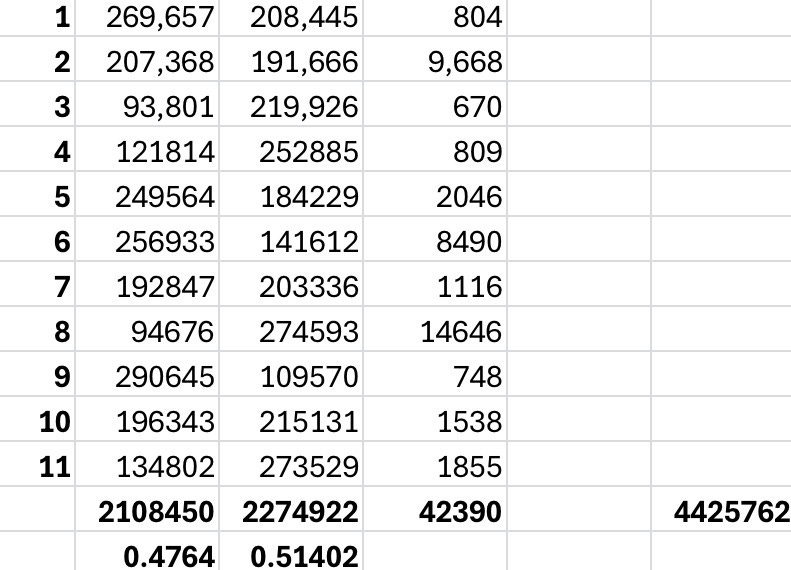
With the lone exception of VA-4, all Democrat districts are lagging GOP-won districts. VA-3, centered on Newport News in the southeast and 43% black, couldn’t give a hoot in hell about this election, and sits over 16,000 ballots behind the next most terrible turnout, VA-8 (Alexandria, Arlington, and Falls Church).
But even if the red districts are running ahead, aren’t there still enough Democrats to get the job done?
Optimistic Case
Election Day turnout - always favors the conservative side or cause. With Republican districts running almost 5 points ahead of Democrat districts already, this suggests there should be a widening of this extending through next Tuesday. In 2024, the Democrat-won districts cast 51.8% of all ballots, an advantage of 3.6% over the Republican-won districts (8.3% left of where we are today). The results (D+3.8%) were almost dead even. With GOP districts having a solid turnout edge and the most decisive Democrat districts in the toilet for turnout, this is a very positive indicator.
Rightward traction - the key point of this analysis lies in the detachment from top-of-the-ticket partisan races (Harris vs. Trump, Spanberger vs. Earle-Sears, etc.) and comparing it to known points of reference. Here are the results of 2020’s Question One - which passed with an overwhelming +31.4% margin, expressing Virginians’ desire to have an independent redistricting commission draw district lines:
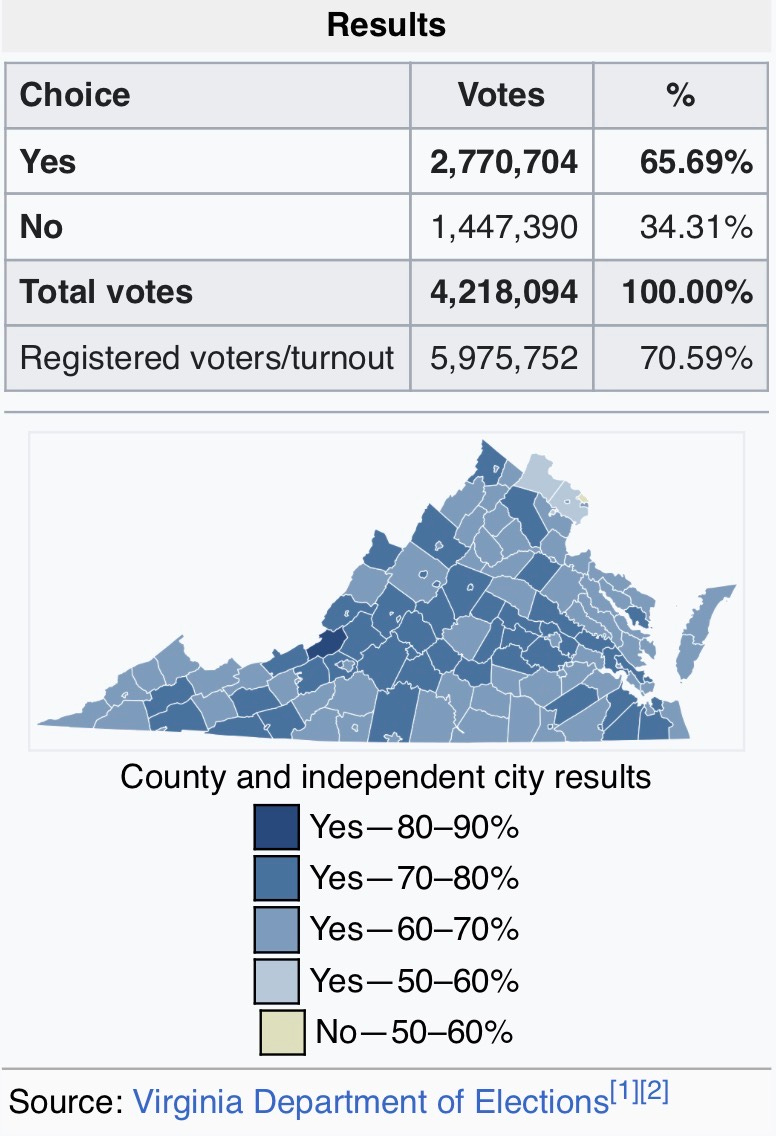
Only Arlington County (Biden +58.1%) voted against the measure, and by a narrow margin. Keep in mind, this result ran 41.5% right of the inflated Biden +10.1% margin over Trump from the 2020 quasi election. With a nearly five-point GOP district turnout advantage right now, a close pairing between the turnout differential and the final U.S. House results in Virginia in 2024, and the likelihood that the above map (heavily in favor of an independent commission) portends a rightward skewing demanding the blues be less blue and the reds be redder (in line with polling suggestions), that leads me to believe this race favors “No” at a glance and certainly rules out a landslide for “Yes.”
Counterpoints and Conclusion
There exists the possibility that the ballot language (restoring “fairness” and other Democrat-aligned bullshit) could confuse voters, and there is most certainly the fact that Virginia’s no-excuse mail-in balloting system waits in the wings to trip up a close race:
Why Off-Year, Midterm, and Special Elections Suck + It’s Still the Mail-In Voting

Today is as good of a day as any to finalize discussion of the November 2025 elections and move into the entryway of what is certain to be another turbulent year in the political space with the 2026 midterms. Honestly, I’m thankful none of the major elections Tuesday were lost in legitimate red states or the Internet would be entirely unbearable right now, instead of just a minor nuisance.
Either way, the mechanics of this race don’t look good for Democrats or “Yes,” and Spanberger with her poor approval numbers most certainly doesn’t help the cause. The race is 100% winnable for “No,” but maximum effort by county GOP affiliates must be expended to get every last conservative voter to the polls, and it would also be nice if some of these mega-GOP donors with billions burning holes in pockets could step up - because they are being massively outspent by a side that wants to turn the land of Washington, Jefferson, Henry, and Madison into a Third World hellhole.


Seth Keshel, MBA, is a former Army Captain of Military Intelligence and Afghanistan veteran. His analytical method of election forecasting and analytics is known worldwide, and he has been commended by President Donald J. Trump for his work in the field.
I don't know GOD'S plan but I do know HE is fulfilling HIS promises of exposing things done in the dark to the light which is truth. This is a time of exposing who and what people are. Who and what are you, Virginia voters? The choice is yours. Decide wisely both for now and your eternal future.
Great commentary Seth. Can’t thank you enough for your nuts and bolts approach to this game. GOP needs to get SERIOUS if we’re going to have a hope going forward!