


Author’s Note: Other 2026 forecasts can be found in the Central File.
I. The Race
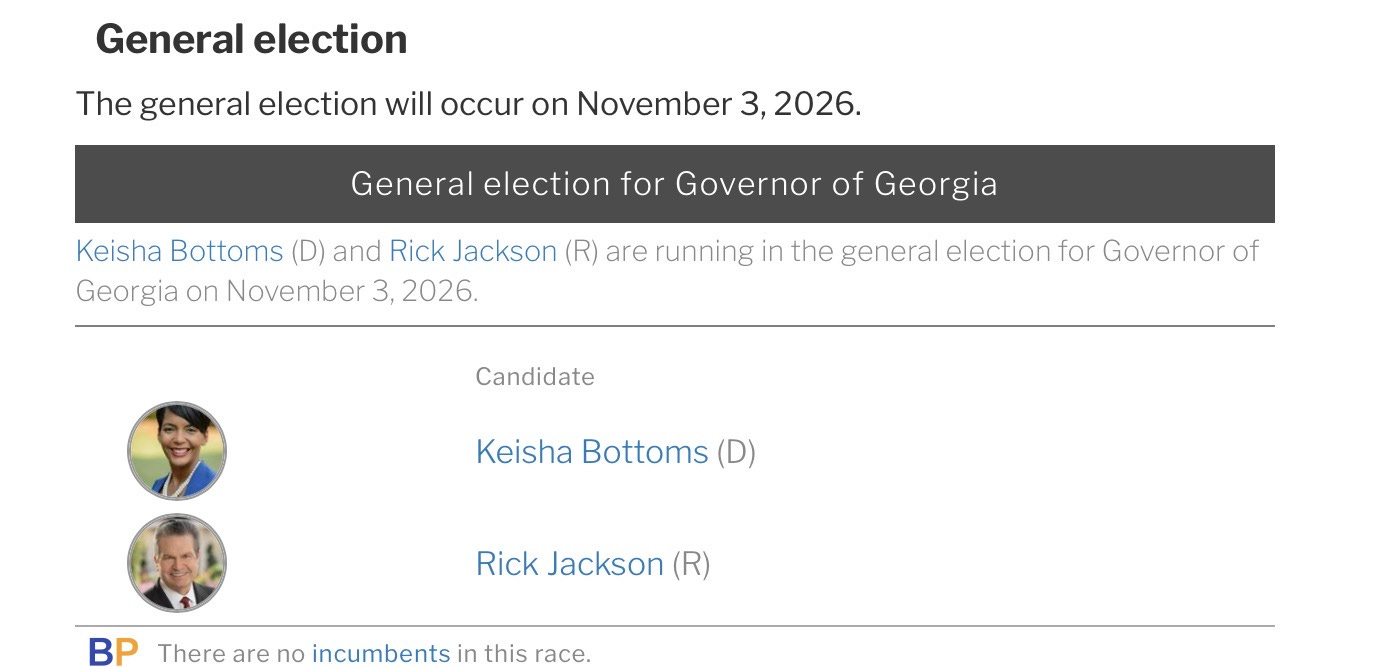
Rick Jackson (Republican) is a billionaire healthcare executive who came out of nowhere to take the GOP gubernatorial nomination from a crowded field of candidates, including Trump-endorsed Lieutenant Governor Burt Jones. He has a relatable story from growing up in poverty and contributed large sums of his own money to finance his campaign.
Keisha Lance Bottoms (Democrat) was once mayor of Atlanta (2018-2022) and later worked in the Biden administration. Her campaign is very loudly anti-Trump to distract from her lack of meaningful achievement as Atlanta’s mayor; if elected, she would be the first black woman to govern an American state.
II. State Profile
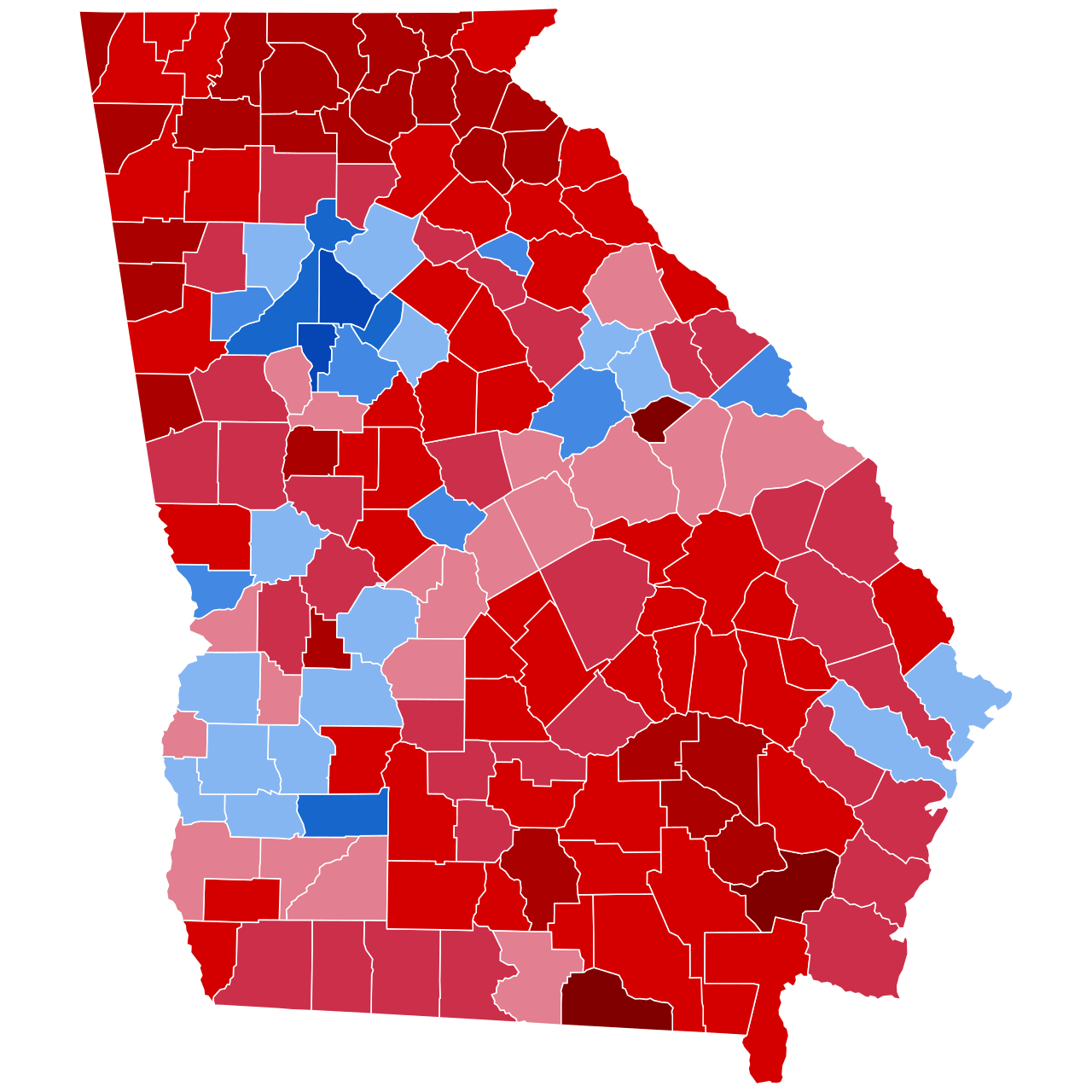
Simply put, Georgia is a looming catastrophe of epic proportions for the Republicans. Perhaps not this year for governor, but almost certainly for U.S. Senator. Without a major change in racial voting patterns, Georgia looks like a blue state to me by 2036 - close enough to get excited about when the first votes drop, but urban and polarized enough to remember better days not so long ago.
President Trump carried Georgia by 5.1% in 2016, and barely had to campaign there despite his lack of political experience. Trump then gained a massive heap of net new votes and ran into Secretary of State Brad Raffensperger’s corrupt elections system and a 634 percent increase in mail-in ballot usage from 2016 to 2020. He managed to keep driving up his vote total in a re-try in 2024, and despite a prodigious performance, carried the Peach State by a measly 2.2%.
Presidential Margins
2016 Trump +5.1%
2020 Biden +0.2%
2024 Trump +2.2%
If you want to get into the weeds and details of the 2020 election in Georgia and other states, read my book, The American War on Election Corruption.
Georgia still has plenty of issues with public confidence in election results, but its political problems remain. The Atlanta metro dominates the rest of the state. Fulton and DeKalb Counties are the two Democrat strongholds making up core Atlanta. They are flanked by Cobb and Gwinnett Counties, two former Republican strongholds of the suburban variety that both flipped in 2016 and gotten bluer and bluer. The graphic below illustrates just how badly President Trump has been smoked in metro Atlanta:
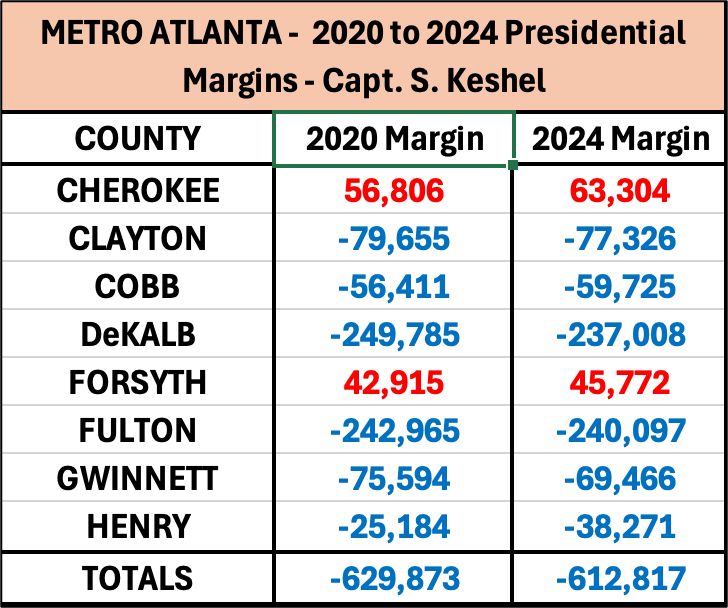
Southern black voters are more loyal to Democrats than black voters anywhere else. In Georgia, from the 1990s until only recently, they were easily outvoted by the extremely conservative white voter base. Unfortunately for Republicans, the turn to Republican populism (“MAGA”) has created a moderate wing of the party that is confined to metro Atlanta that has been instrumental for declining margins not only in northern Fulton County, but also in suburban counties like Forsyth and Cherokee Counties.
The rural counties of Georgia (outside of the “Black Belt” rural counties that support Democrats) are overwhelmingly red. The issue is that they are maxed out and practically incapable of producing notably larger margins in absolute votes. Any major growth in Atlanta without progress with voters there, or further slippage in suburban counties, makes a blue Georgia increasingly likely in coming years.
Key Statistics
53.2% White, 32.3% Black, 10.5% Hispanic
III. Market Assessment
Polymarket bettors favor Bottoms, but Jackson is still considered competitive and subject to the same wild swings in these markets impacting all GOP candidates.
IV. History
Georgia’s gubernatorial history closely resembles Texas’s, even if the current chapter started eight years later than the Lone Star State’s. In 2002, Sonny Perdue was elected governor of Georgia, defeating Roy Barnes. In winning that race, Perdue became the first Republican governor of the Peach State since Reconstruction. He served two terms and gave way to Nathan Deal, a former Democrat, who won in 2010 and took over in January 2011.
In 2018, the first electoral test of the state since Trump’s election win, Secretary of State Brian Kemp was the GOP nominee for governor in a race everyone overlooked. It nearly backfired, but Kemp held on by a tiny margin over progressive favorite Stacey Abrams.
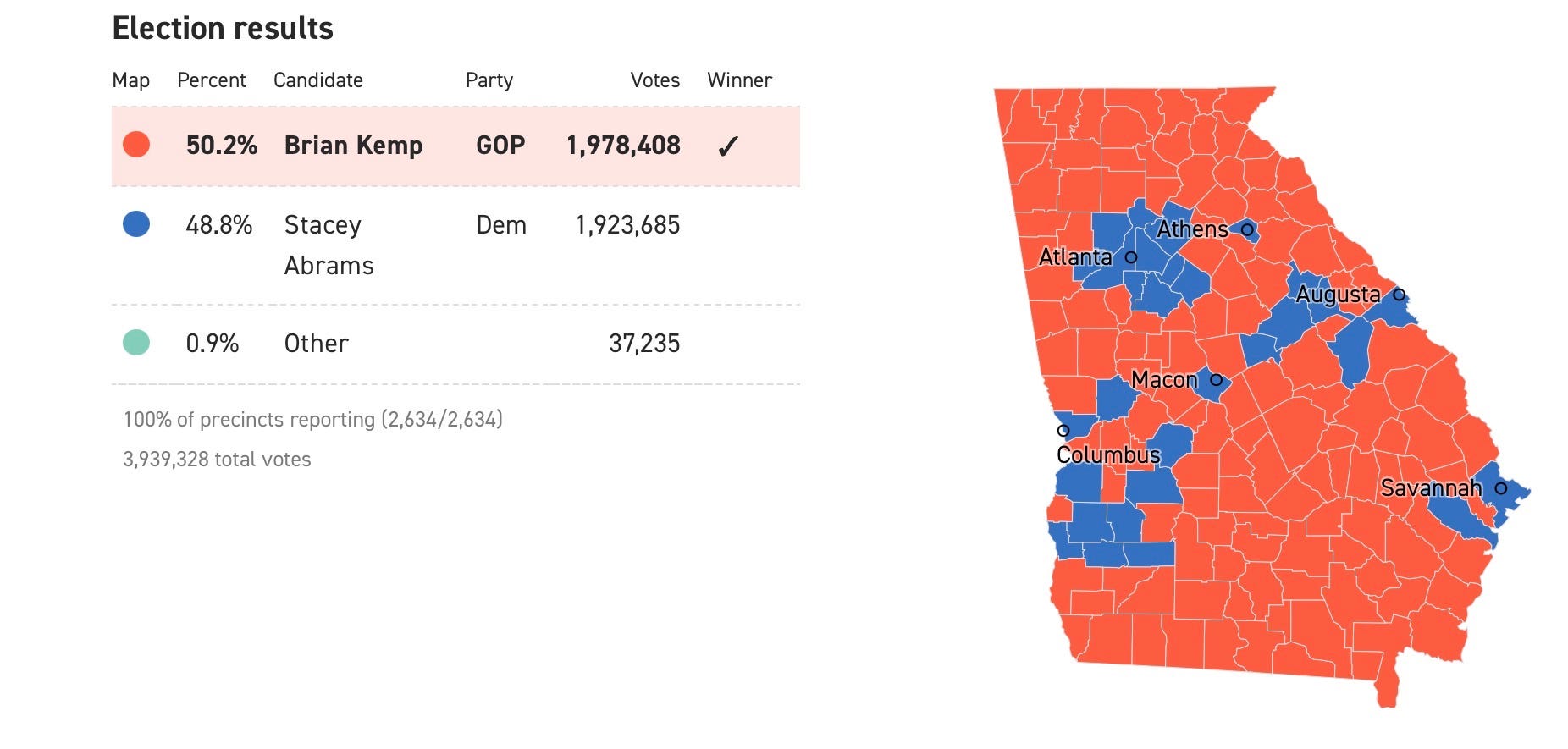
Just 54,723 votes, 1.4%, separated Kemp and Abrams, thus preventing the good people of Georgia from having this individual as their governor:

Kemp wound up waffling on his pledge to root out the corruption of the 2020 election and sided with Raffensperger over Trump; this earned Trump’s ire, so he endorsed former Senator David Perdue to primary Kemp in 2022. Kemp throttled Perdue, then wen t on to beat Abrams soundly in a rematch in the General Election (+7.5% margin).
To conclude, the modern history of Georgia suggests the state prefers Republican governors. It should not surprise you that an anti-Trump state rewarded the governor who stuck it to Trump the most, and this is an important thing for understanding how things next week will likely unfold.
V. Analysis of 2026 Primary Results
This is going to highlight a major Republican problem that will be a recurring theme in Georgia.