


In the closing weeks of the 2024 election cycle, I learned I had become a secret weapon for gamblers who were looking to cash in on President Trump’s impending victory. See if you can spot the one-month spike in my paid memberships:
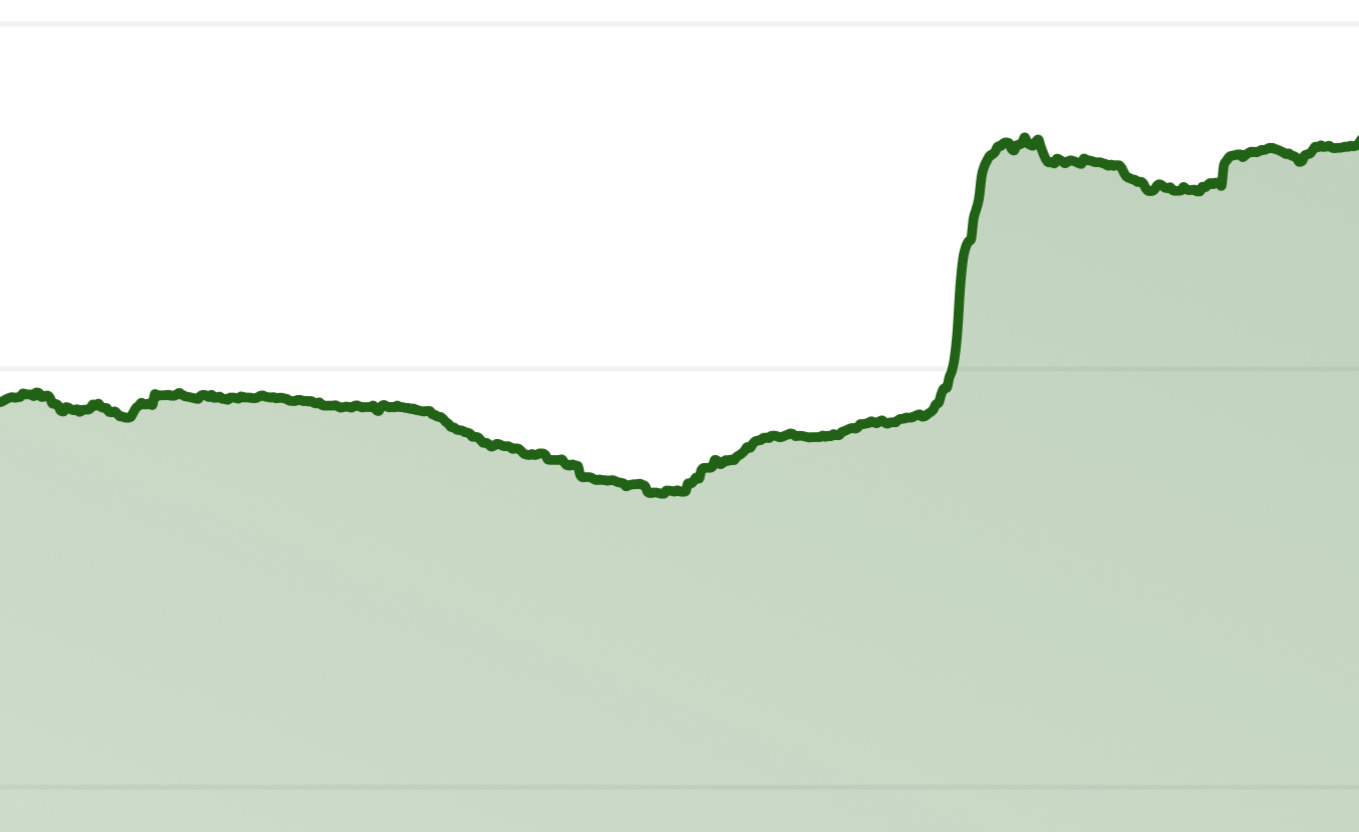
That big spike on the right side of the graphic grew my total paid readership by more than 20%. With a lot of hard work and a few breaks, I’ve maintained it; Polymarket knew I was on to something when they had me for a Substack interview that ran on October 10:

I got laughed at by a few commenters after I gave these takes:
New Hampshire. I think Trump is at least 1 in 3 to take New Hampshire (🔮88% Harris in NH). If Trump sticks to his average performance off the voter registration index in two cycles in each of the counties, particularly Rockingham and Hillsborough, he has an edge of just under 5,000 votes there, which is subject to change with any updates or exploitation of election loopholes there. I don’t think either candidate has a ceiling in New Hampshire of much more than 10,000 votes, and if Trump manages to take a large victory, four states come into view - Virginia, New Hampshire, New Mexico, and Minnesota, and likely in that order. The other six states I group into the decisive states - Arizona, Nevada, Georgia, Michigan, Wisconsin, and Pennsylvania - would have already gone for Trump, along with North Carolina by a lot.
Trump Blowout Victory. Polymarket has odds for a Trump blowout victory (100+ electoral vote margin) at 11% and I think it’s around 25%. This is defined as something like Trump at 319+ electoral votes, which would mean he takes North Carolina and the six decisive states I just mentioned (312) plus Minnesota (322) or Virginia (325), or a combination of New Hampshire and New Mexico (321). Of all these, Minnesota is the least likely to go for Trump thanks to the actions of the Democrat trifecta legislature and governor, plus the “fortification” of the Twin Cities metro, which dominates the vote.
Florida Margin of Victory. There is a market on whether Trump will win Florida by 8+ points (🔮38% odds). I’d buy that with Trump projected to be 9-12 points up. Based on my registration modeling I’d give him a 75% chance to exceed 8 points. You have all 67 counties in the state with a rightward shift, and Trump doing much better with Latino voters. I would love to see a market on if Florida will vote to the right of Texas, I think it will. It is also a bullish sign in favor of a Trump landslide in Florida that Milton could have been much worse and likely will not depress pro-Trump turnout to great extent.
Every piece of advice I gave that day was right on the money. Not long after that, I sank Ann Selzer’s ship and maintained Iowa would go to Trump by a ridiculous margin:
My Take on "Harris +3 in Iowa" and the Battle for Narrative

Yesterday, I planned to minimize my time consuming election information and posting on social media and instead work on a few battleground state predictions, and wound up pushing out two – Nevada and Arizona. That plan changed for worse when Ann Selzer, the vaunted “gold standard” pollster of Iowa, pushed out a Harris +3 poll
People all over the world were ignoring the legacy media and trusting the data. It is time to play this game again. Of course, the standard disclaimer exists - that I am not responsible if you don’t win. If you do win, you should tell me so I can brag about it on here.
One of the interesting stories about how I got involved in election integrity revolves around my own bets on Trump’s 2020 election chances. All of my research suggested larger Trump margins of victory in every Midwestern state he won in 2016, and I could triple my money by picking him in places like Pennsylvania or Wisconsin because gamblers were following along with the mainstream media’s lies.
I haven’t bet on any elections since then, but it is always interesting to take a look at the odds. Selzer knew that her bad Iowa poll would tank Trump’s odds nationally and most importantly, in Wisconsin, where there is high correlation with Iowa’s political dynamics.
WHY PEOPLE MAKE STUPID BETS
Personal bias and partisanship - “my party is the best party.”
Fallacy of consensus - “everyone I know is voting for this guy.” I had this taint my view of the 2012 election because just about every Army officer I was serving with couldn’t stand Barack Obama.
Ignoring history - my speciality is reminding you of history - like there having never before in a presidential election been a red Nevada with blue Arizona (so don’t believe polls suggesting it).
Propaganda and lack of B.S. filter - perhaps the prime reason people make dumb bets; they bite on garbage polling and ignore readily available information that would cause them to second guess their bets.
Bandwagon effect - people see the chances of a particular candidate climbing because of the four reasons above, and jump on board rather than recognizing an opportunity to buy the underdog.
CASE STUDY
Last week, I called out a poll by NextGen, which has Katie Hobbs leading both main GOP gubernatorial contenders by roughly 20 points each:
On to another battleground - my sunny Arizona home.
Some readers have asked about my take on NextGen Polling’s release showing incumbent Governor Katie Hobbs (Democrat) leading her two main Republican challengers:
Leading Andy Biggs 51-32% (+19%)
Leading Karrin Taylor-Robson 51-30% (+21%)
The other two polls available for this race on the RCP website give Hobbs an average lead of 1.5%, typical for this time of year with no GOP nominee officially slated. Thanks to polling, especially ridiculous ones like NextGen’s, Polymarket’s Arizona Governor Election Winner Predictions & Odds favors Hobbs with 67% over the GOP nominee’s 34%.

These odds have nothing to do with Polymarket’s opinions; they represent the way the bets have been coming in. When Selzer threw out her phony Iowa poll, the markets ran heavily toward Harris up until Election Day. Here, if you pick the GOP nominee and buy a single share at 34 cents, a win for said nominee over Hobbs will be worth $1.00. Picking the Republican nominee (likely Andy Biggs) nearly triples your money. Someone buying Hobbs shares today stands to gain roughly 50% on the investment if she wins (or “wins”).
Some of these markets are realistic and foolish to go against. For example:
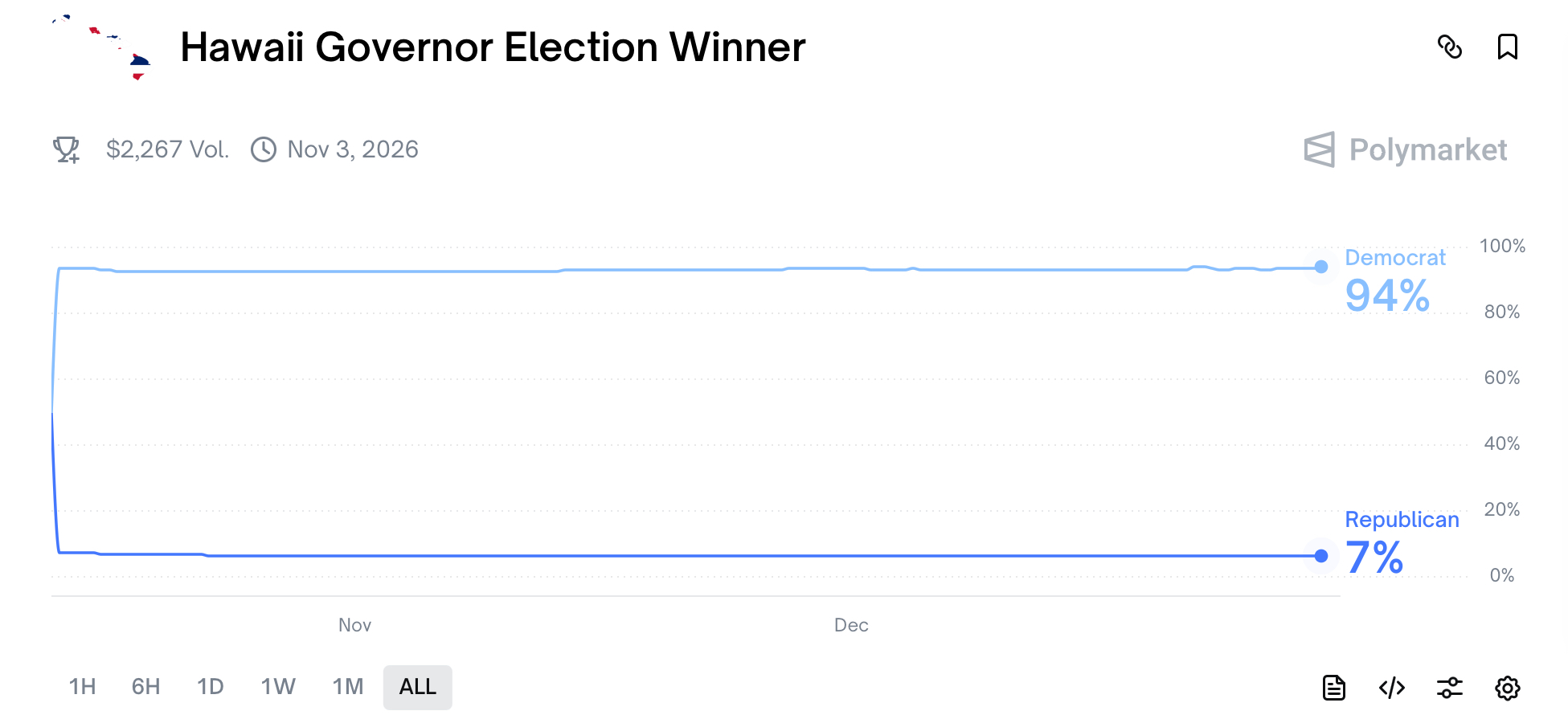
Uh, yea. The Democrats are as likely to win the Hawaii gubernatorial race through the combined powers of bad ideology and mail-in ballot collection as I am to drink three cups of black coffee typing my Substack pieces. The massive fluctuations in markets belong to the races being most manipulated by bad press and bad data.
BUT WHAT DOES HISTORY SAY?
In 2022, when then-Secretary of State Katie Hobbs administered her own election against Kari Lake, Arizona’s party registration figures looked like this:
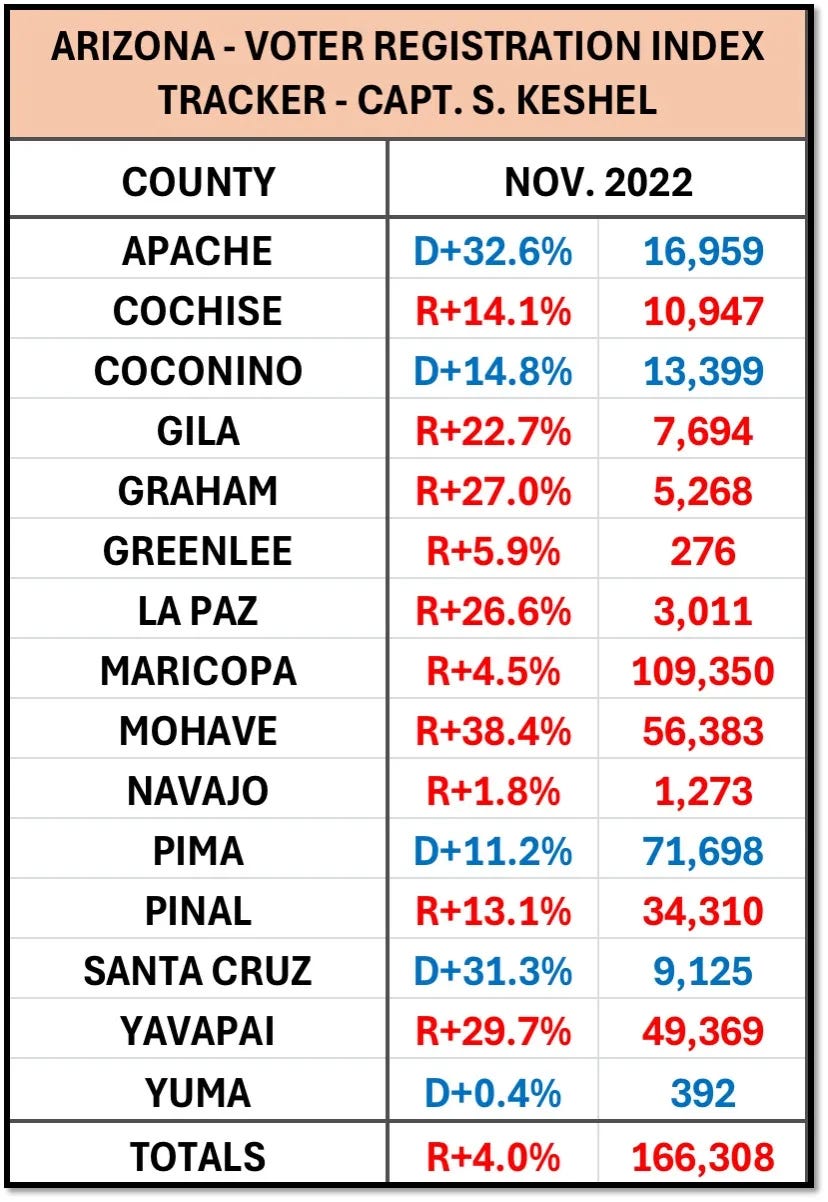
Republicans led Democrats by +166,308 registrations, or +4.0% statewide. Hobbs “won” her race against Lake by 17,117 ballots, or 0.5%. That means Hobbs ran like this relative to party registration:
4.5% left of registration percentage
183,425 left of registration count
Today, party registration in Arizona is R+7.5%, or +328,534:
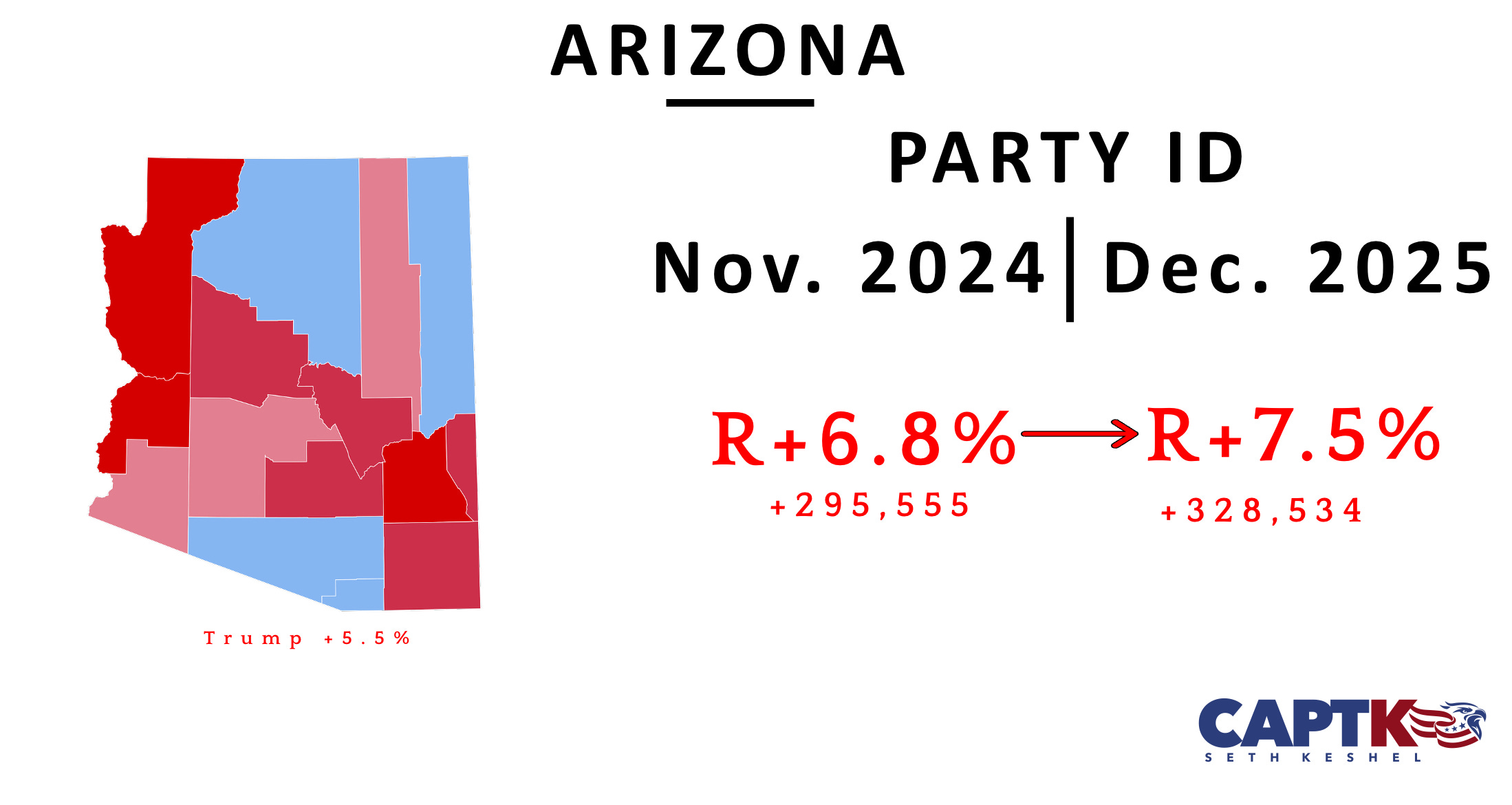
All 15 counties are shifted right since 2022, and they perfectly predicted the rightward shift present for Trump in all 15 in 2024. Hobbs’ 2022 performance, if set equal to today’s party registration numbers, would give an outcome like this:
Republican win +3.0% (4.5% left of registration percentage)
Republican win +145,109 (183,425 left of registration count)
Andy Biggs represents AZ-5, and won his race in 2024 by roughly 21 points, running slightly ahead of Trump in that district. Trump, running behind Biggs in AZ-5, still won Maricopa County, and with it, the state by 5.5%. Biggs is a solid bet to capture a dominant share of the Mormon vote, which is the squishiest registered Republican vote in the state. You get that, you get Maricopa. You get Maricopa, you win.
YEA, BUT THAT’S ONE EXAMPLE - WHAT IF THEY CHEAT?
The cheat is baked in to the cake with more than three-quarters of the vote coming by mail. Maricopa County Recorder Justin Heap recently cleared more than 140,000 registrations from the county rolls, which will help, but eventually, the party registration numbers become too dominant for the underdog to win. Check out Democrats in Florida today - within a breath of preventing Ron DeSantis from ever serving as governor in 2018, and now a laughingstock of a party on par with the Colorado Republican Party.
Now, here is where I come armed with data.
I have party registration figures back to 1924 in Arizona. The state ran gubernatorial races every two years until 1970, when it moved to a quadrennial format. The only gubernatorial years without party registration figures are 1942 and 1944. The Arizona Republican Party took over the voter registration advantage in the state in 1986 and has never once relinquished it. Prior to then, it had been voting Republican for President (no misses) since 1952, but still playing ball with Democrat governors and Senators.
In 33 of 35 hypothetical matchups with today’s party registration figures, Katie Hobbs loses the governorship. The only historical exceptions would be:
Bruce Babbitt (1982 reelection) - popular incumbent running in a Reagan recession midterm (pre-boom), had important accomplishments on water management and healthcare, and prosecuted land fraud; ran 27.6% left of D+2.4% party registration advantage in a 30% blowout of a weak Republican and strong libertarian vote stealer.
Janet Napolitano (2006 reelection) - a pragmatic moderate who only slipped up after becoming part of team Obama, impossible to beat from the get-go with a high approval rating; ran against weak Republican challenger and beat him from the right by deploying the National Guard to deal with the border emergency. Ran 33.4% left of R+6.2% party registration advantage and won every county. The performance against the registration count, 576,764 left of the R+160,462 advantage, is the only one of 35 performances strong enough to top the current R+328,534 advantage.
Notably, Napolitano would have lost in 2002 (when she won by +1.0%) with the current GOP registration advantage.
In short, for NextGen to be right, Katie Hobbs has to be Bruce Babbitt or Janet Napolitano, and explain how the raw registration advantage for the GOP has nearly doubled in her stint as “veto queen,” which has plunged Arizona to near the bottom in new job creation.
CONCLUSION
Katie Hobbs can win in 2026, even if those odds are 2-in-35. Statistically, she shouldn’t have won in 2022, either, but did so by only 17,117 ballots against a +166,308 GOP registration advantage in what is one of the worst cheat fests in American history.
This time, she will have to replicate her performance against a Republican lead well over 300,000. NextGen, in having her leading by 20 points, is forecasting a 700,000-vote margin of victory, which would run roughly one million left of the registration count, more than 400,000 left of where Napolitano landed in 2006
It is time to start believing real research and kicking propagandists and politically illiterate firms to the curb. And now is a good time to bet on the GOP to win the Arizona gubernatorial race.
Seth Keshel, MBA, is a former Army Captain of Military Intelligence and Afghanistan veteran. His analytical method of election forecasting and analytics is known worldwide, and he has been commended by President Donald J. Trump for his work in the field.
We (the wife and I) lived in California from the early 1970s to the early 2010s and are guilty of having made a living in what used to be called "show business". We find amusement in our very old age in seeing how much Hollywood accounting has carried over to the digital age. The Captain makes money the old-fashioned way; he earns it. In the world of expert opinion he is up against all the people like NextGen who never have to show a profit. That is why, on the Captain's wish that real research will be believed and propagandists and politically illiterate firms will be kicked to the curb, I have to bet the under for 2026. (The wife never gambles; that is how we kept our ill-gotten gains.) But, we both think he and the very few brave, smart people like him will somehow manage to lead the country to victory in the war for liberty of conscience. On that we take the over.
US citizens are not allowed to bet on Polymarket. Just tried opening an account.