


You can get it right, and people forget about you the next day and call you crazy when you pop your head up for another round of predictions. That’s life in forecasting elections and world events. Slow and steady wins the race, and dumping entire models to keep up with consensus is never a good idea. The current consensus, at least on the markets, is that Democrats are overwhelmingly favored to win the U.S. House:
That ridiculous number (83%) for Democrats is built on two things:
Polling (generic ballots as high as D+11)
Precedent (the president’s party loses seats in 20 of 23 midterm elections since 1934, with an average loss of 27 seats)
What gamblers aren’t factoring in is the drastic impact of new maps all across the U.S., which has now turned to favor Republicans. I laid down baseline predictions for 390 seats earlier this week, and found that the baseline for this House election starts at 203 Republican to 187 Democrat:
Cumulative 2026 U.S. House Overview: Full Seat Ratings Start at 203 R/187 D

On April 3, I wrote a sober-minded article with the following verbatim quote:
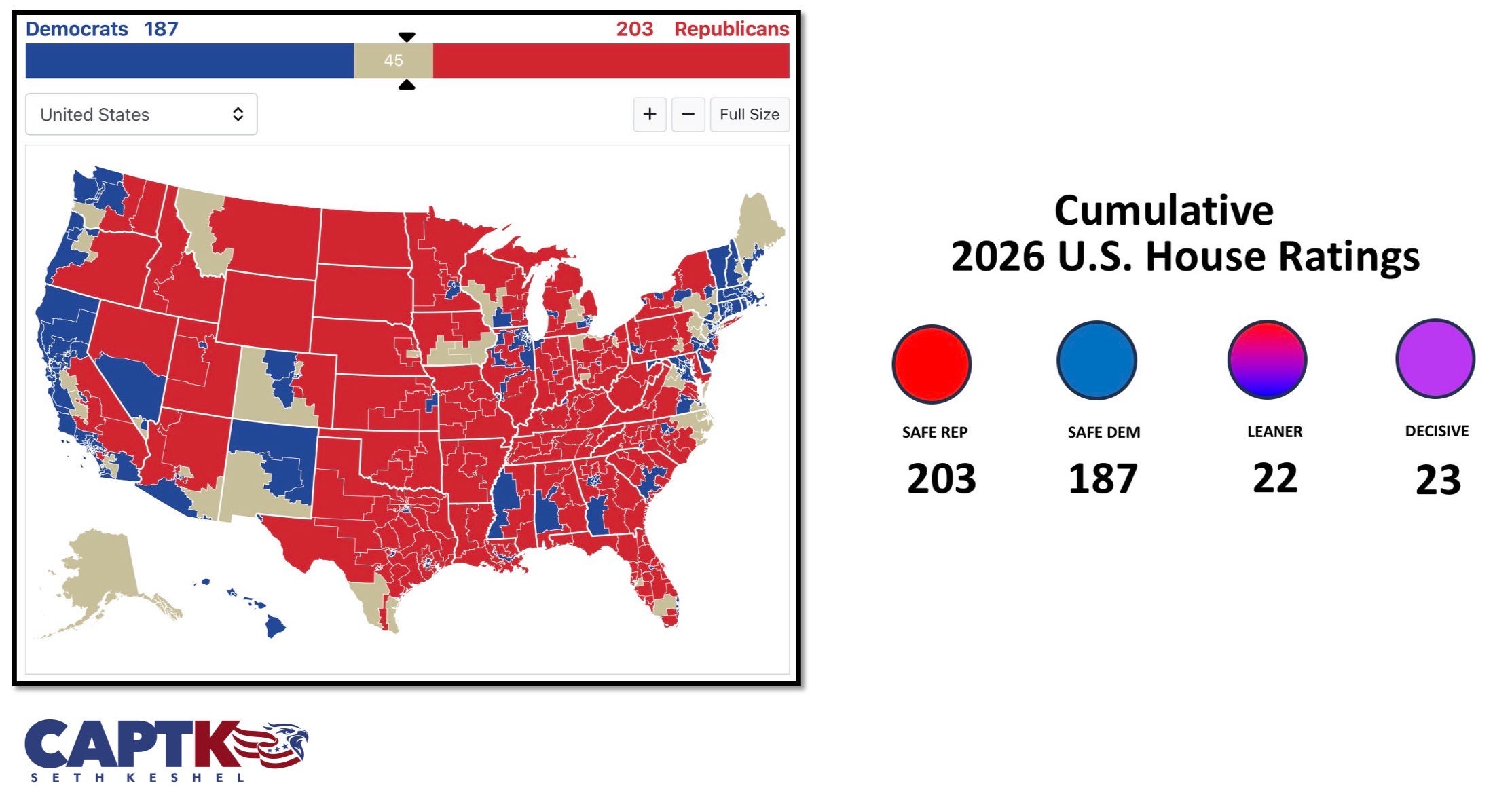
What this means is that just 10.3% (45) of House seats will decide the majority, and that neither party has a high ceiling nor a low floor. Democrats need to win 31 of those 45 seats (68.9%) to win the slimmest majority possible (218 to 217). The predictions get much harder after the “safe” round, and I’ve separated what remains into two categories:
Leaners
Decisive
The leaners are those seats in which I have a higher degree of confidence of who the winner will be. In the last presidential cycle, I put the following electoral votes into the leaner category because I knew they weren’t “safe” states, but also didn’t think they were anyone’s for the taking barring scandal, unforeseen development, a wave election, or just a massive upset:
Maine Statewide (2 electoral votes, Harris)
Minnesota (10 electoral votes, Harris)
Nebraska’s 2nd Congressional District (1 electoral vote, Harris)
New Mexico (5 electoral votes, Harris)
North Carolina (16 electoral votes, Trump)
Virginia (13 electoral votes, Harris)
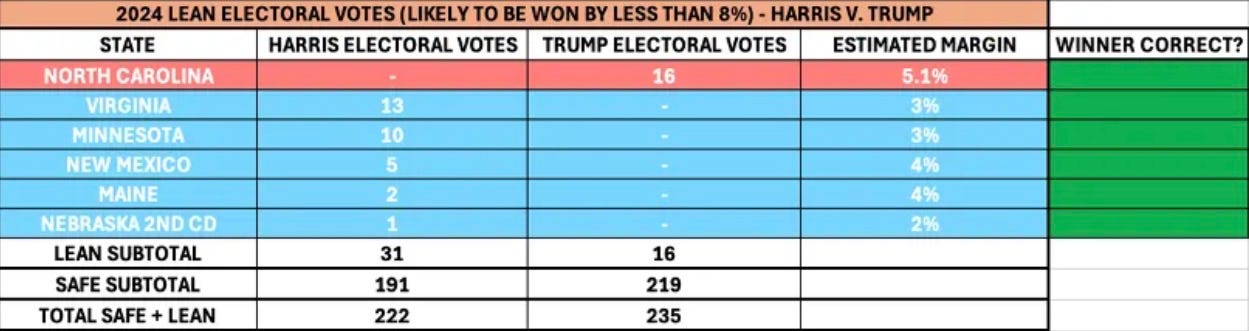
I got them all right, and that created the second base camp of 235 to 222 Trump, which gave way to victory scenarios. Trump nailed the first and straightest path, the Core 235 + Georgia (16) + Pennsylvania (19) for an even 270 on Election Night, closing the books on Harris’s miserable campaign and paving the way for the online right to bitch 24/7 for the next four years (currently ongoing).
Examining Leaners
I’d be stunned if I missed more than a handful of the “safe” seats, but with 390 opportunities to miss one, I suppose an upset is always possible. Still, the seats are cut in such a manner to preclude upsets by design. I’d call Eli Crane in AZ-2 (R) my iffiest “safe” Republican seat, but the Democrats have a very static electorate there and their own internal comms don’t seem very bullish on it. Leaners have an obvious favorite, often aided by incumbency, midterm year dynamics (blowback against president’s party), and other factors. Here are my 22 leaners, followed by how I think they will break: