


One of the first things anyone notices when they first visit Texas is the grandiose way the state presents itself. Even in Austin, it’s cowboy hats, western apparel, football, and pickup trucks. You can’t walk two blocks without seeing some caricature of a western man about to throw a lasso while wearing a pair of six-shooters on his hips.
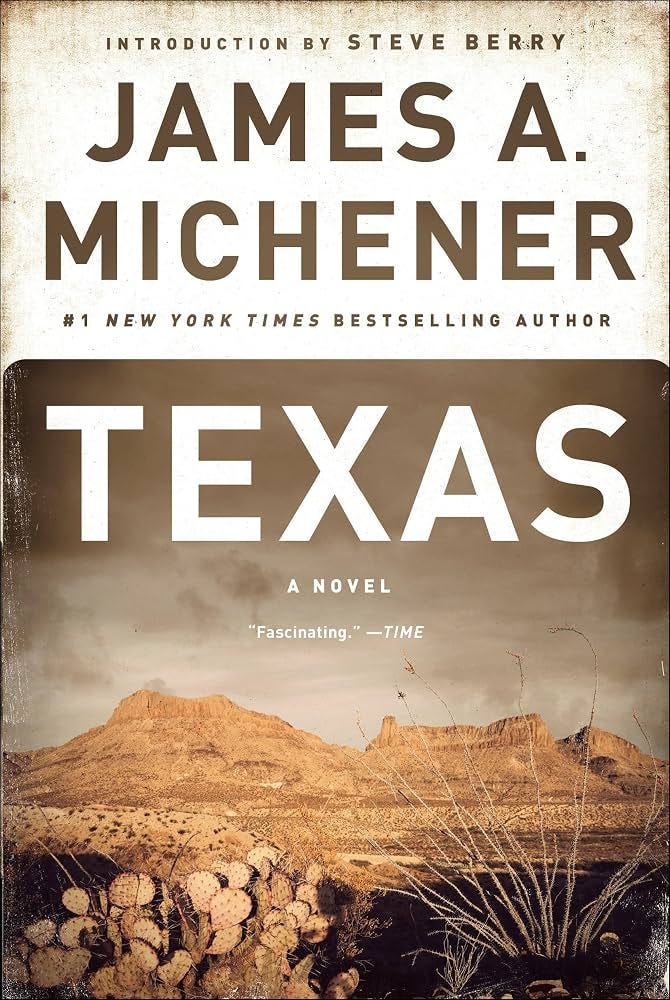
Everything is bigger there. The state has its own appeal and attitude, and is always thought of as most likely to secede. Of course, Texas was once its own country. You can read all of these Texas legends in a great 1,100-page book I once willed my way through, James Michener’s Texas:
Near the end of the book, as the story reaches the 1980s, Texas’s transformation from “Solid South” Democrat state to Republican stronghold is documented. This happened overnight at the presidential level, and took three decades to fully click over into the state legislature. Democrats lost their legislative power in the early aughts, and haven’t won any statewide election in Texas since 1994 - when Dubya knocked Ann Richards out of the governor’s mansion.
Since then, Texas has been written off as a GOP cakewalk for political observers. Democrats have responded with their own PR playbook, fantasizing over polling and insisting that because of “demographic change,” Texas is destined to become the next California. What they actually mean by that is that they are thrilled about their plan to displace the percentage of non-Hispanic white voters with not only Hispanics, but many unassimilable foreign groups that will give birth to American citizens while here on our soil.
Despite having no mishaps since the 1994 streak, now believed to sit at 189 consecutive wins, there have been some uncomfortable margins recently. In 2018, Democrats gave it their best shot in the Senate, as Robert Francis “Beto” O’Rourke fought Ted Cruz, who ran one of the laziest campaigns in American history, inside three points (the same year Ken Paxton won reelection as Attorney General by less than four points against a relative nobody). Abbott pancaked his no-name Democrat opponent that year, but 2018 was the best shot for Democrats in over two decades at getting back in the game because it was the first GOP president’s midterm for someone not named Dubya since Texas became a hardcore red state free of “blue dog” Democrats.
Then came the 2020 presidential election, marred by COVID-19 and cheating, which kept Trump to a 5.6% margin of victory - the closest in a Texas presidential race since 1996. I met with AG Paxton to discuss that dubious result in 2021, which both of us believe is one that makes no sense. Biden somehow finished with nearly 600,000 more votes than Trump won the state with in 2016, and cleared 5.25 million votes when no Democrat presidential candidate had ever even received 4 million previously. But since Trump won the state anyway, it didn’t get enough attention.

Now Paxton is in the fight for his political life against a rat-faced, communist candidate named James Talarico who is so weird, he makes Austin look like a rigid society of straight-laced businessmen reading newspapers on the train to work. Against a candidate who believes a welcome mat should be on the border of Texas, that the standard Democrat list of scary guns should be banned from private ownership, and that there are specifically six genders. The fight for his political life - as we are led to believe by practically every damn poll coming out right now:
Now, you all should know how I feel about polling. I am not here to dissect more polls, because they are getting dumber and dumber:


The real poll will be revealed on November 3, and as I’ve written previously, Texas polling usually understates Republican support - often in grand fashion. Still, paired with 2018, 2026 represents the next great chance for Democrats to fluke their way into an upset we absolutely do not need to happen. If you want to start passing blame, don’t blame the president. I believe he put Texas on its pathway for political salvation by destroying more than a decade’s worth of Democrat inroads in one evening:
How Trump Saved Texas, In One Stunning Image

One of the most pleasant surprises of President Trump’s 2024 victory was his 13.7% victory in Texas, a crushing blow to decades of Democrat fantasies of turning the state blue and eliminating any pathway for a MAGA candidate to win the Oval Office. Trump had won the state in 2016 by just 9.0% (807,179) and 5.6% in 2020’s cheat fest (621,221), putting th…
This is the person you should be blaming:
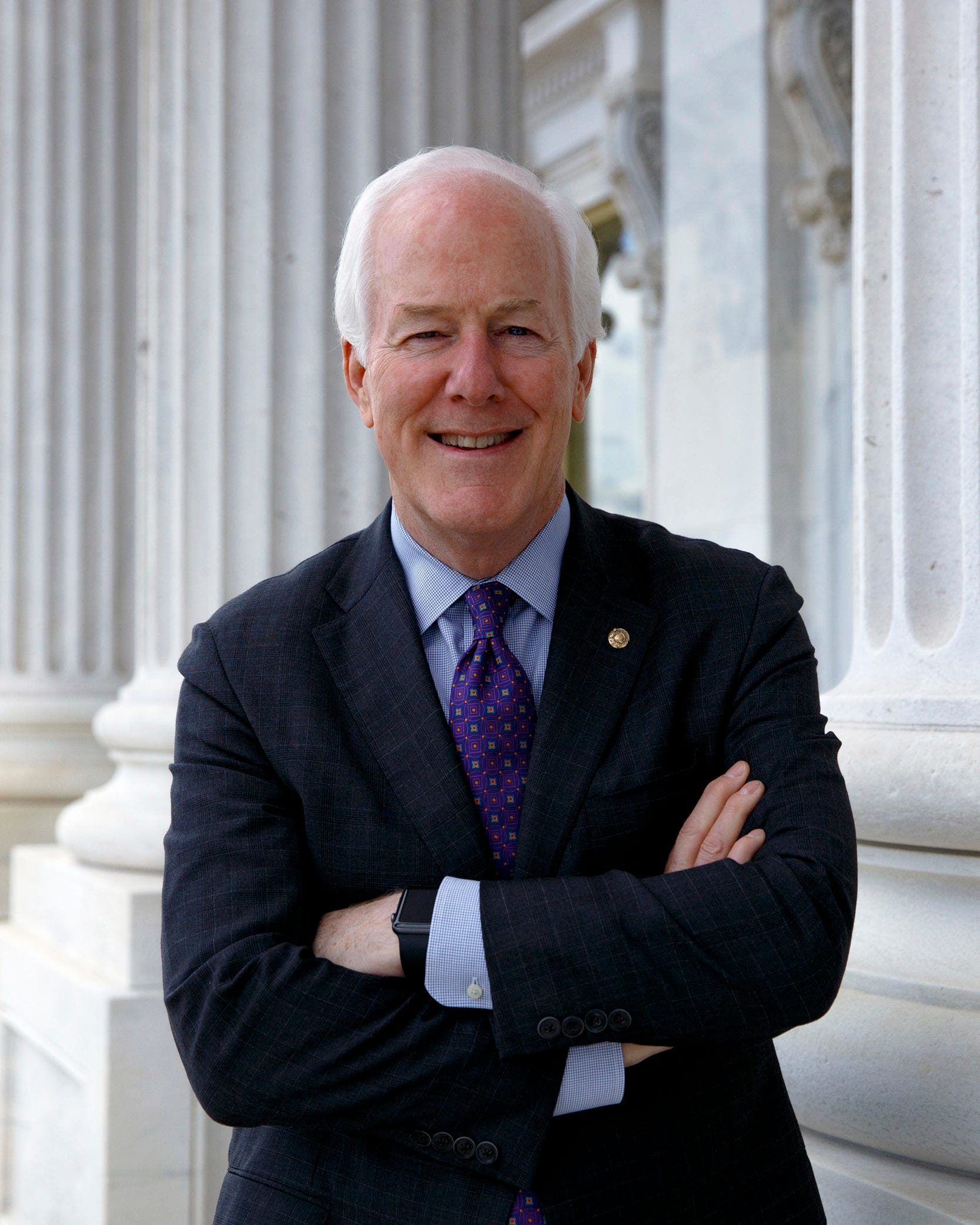
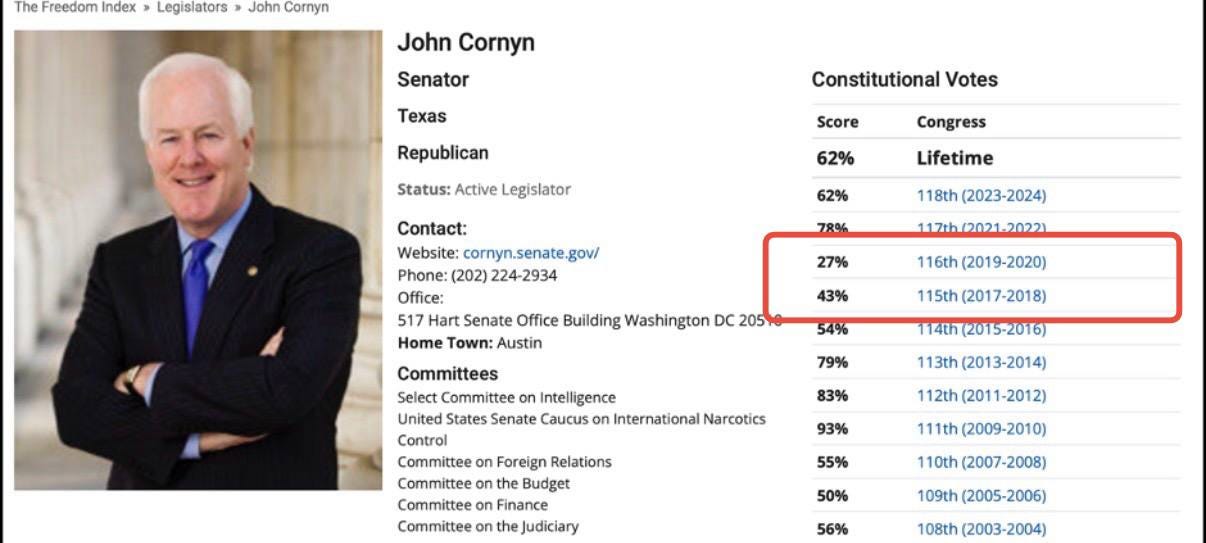
John Cornyn, whose staffers are joining Talarico’s campaign because they can’t process the Texas-sized ass-whipping they were dealt in the May run-off against Paxton. That’s the guy - the one with practically zero modern credentials who is now looking to break all the toys and stomp off because he couldn’t convince GOP voters to give him a fifth trip to Washington, D.C. Maybe because they saw that he had his worst voting record during Trump’s first term and only plays “conservative” when a Democrat is in office?
Lest I get stuck ripping on the Bush establishment, I’m going to move on to modern-day Texas and the challenges it presents. Florida, stunningly, despite its urban build and huge population influx, is in a league of its own. I write about voter registration by party every month, and Florida is becoming exactly what Texas became several decades ago - an impenetrable GOP fortress.
September 2026 Voter Registration by Party Updates for Key 2026 and 2028 Battlegrounds

Author’s Note: For a summary of why voter registration by party is so important, and to understand the importance of these states and why each were selected for this recurring study, please see the March 2025 summary.
This is not a blue Texas scare I’m issuing here. I’m not really a believer in that; however, politics is a constantly shifting landscape that requires diligence and an understanding of the enemy’s playbook if you want to win. These three considerations are the most crucial for understanding why Texas is no longer a 20-point romp, and sits just one election cycle away from upending the national map as we know it:
I. Big Tech, Big Expansion
There are four major metro counties that impact elections in Texas. Democrats would like to see El Paso expand significantly and become the fifth, but the current kingmakers are Harris, Dallas, Travis, and Bexar Counties. In order to win Texas, Democrats need huge margins in all four, then need to have the following impacts on these six:
Fort Bend County - win by 15% or more (suburban Houston)
Montgomery County - lose by less than 35% (suburban Houston)
Tarrant County - win by more than 5% (Fort Worth and suburbs)
Collin County - flip narrowly (suburban Dallas)
Denton County - lose by less than 5% (suburban Dallas-Fort Worth)
Williamson County - win narrowly (suburban Austin)
In the 2000 presidential election (Bush +21.3%), these ten counties accounted for 53.4% of the vote. In 2024, that number rose to 57.2% as Texas’s population boom persisted:
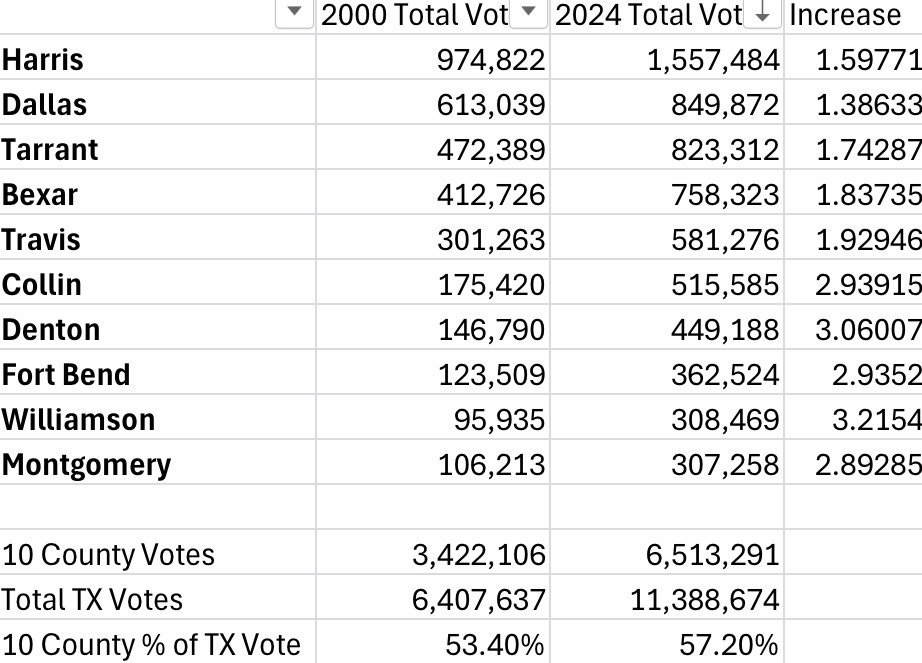
An increase of 3.8% may not seem so extreme for 10 counties, which added nearly 3.1 million votes collectively, but they spawn entirely new suburban and exurban counties as they push the older population further away. That’s where you get Parker (my old home county), Ellis, Hays, Bastrop, Johnson, Brazoria, and Kaufman Counties from. Without those exurban counties, the electoral terrain in Texas gets a lot tougher. Roughly 90% of the vote in Texas is urban and suburban (or exurban). The frontiers you read about in the novels are vastly disappearing from electoral significance.
When I was a young Army officer stationed at Fort Hood starting in 2009, Austin was the “cool spot” many of my peers spent their free time in. As the numbers above demonstrate, it was much smaller back then, and the political makeup was roughly 55D/45R. It had your Willie Nelson-style hippies and an arts and music scene, but also the quiet feel of an overlooked capital. The 2010s sent Travis County and Austin into the stratosphere, and it was a self-inflicted wound. Texas promoted the hell out of its capital city, and the communists infested it like locusts. It is no longer a Willie Nelson vibe there, but a Che Guevara one. Travis County gave Barack Obama a margin of less than 93,000 votes over Mitt Romney in 2012; in 2020, Biden beat Trump by over 274,000.
Read that again - in eight years, the Democrat presidential margin swelled by three times in raw terms. That was a self-inflicted wound, and largely due to the mass expansion of big tech. Company after company has cashed in on Texas’s business environment and brought their hardcore leftist employees with them, as well as droves of visa holders. They have turned Austin into something much more like the Bay Area than the “live and let live” culture they act like they have. They are downright hostile, and the white leftists there love Talarico, who dominated the Democrat primary in Travis County and the surrounding area. They will produce a near-presidential turnout there in November, and AG Paxton will essentially start out a quarter million in the hole and need to get makeup margins elsewhere. Democrats are likely to be pushing presidential margins of +400,000 by 2032, despite Trump’s marginal improvements in Travis County in 2024.