


Believe it or not, I am already taking on questions regarding the next two election cycles. I have come to realize that election season is an enduring thing that never really ends, kind of like how the NFL season proliferates itself through the calendar in unique ways:
· Regular Season runs from the beginning of September to the beginning of January
· Playoffs and Super Bowl take place in January and February
· Pro Bowl and NFL Combine take place in February and March
· NFL Draft takes place in April
· Minicamps take place in May and June
· Training Camps take place in July and August
There is never a respite from the monetary juggernaut known as the National Football League, and no shortage of people to suck up the wall-to-wall coverage. Now, compare this to election season:
· Early Voting begins as early as September, and runs through October into November
· “Election Day” is in November
· Election Counting and Challenges take place in November and December
· Election Winners are Seated by the end of January
· Candidates begin filing for future races in February
· Campaigns begin hiring staffers and consultants in Spring
· Election season in full swing for 18+ months until “Election Day” cycles back around
With all of this succinctly laid out, then it should be clear we are at the foothills of campaign season, with election season underway. Not only have candidates stepped out of the 2026 race, but candidates are also stepping in. It’s a vicious cycle that warrants constant attention because losing the upper hand has severe consequences. Although it is far too early for me to make definitive predictions like I did when I whipped the mainstream media’s magicians and sorcerers with perfect predictions in all 56 races for electoral votes, it is not to early to give you, my valued readers, the lay of the land, and also provide myself an anchor point to base those ultimate predictions off of when the time comes in about 20 months.
Without further ado are the Top Three 2026 midterm considerations for you to chew on in February 2025:
I. History Sets the Table
There is a reason scholars created the subject of political science. I use it to forecast presidential elections, and those who are wise and willing to listen heed its wisdom when it comes to midterm elections. Political science governs the headwinds and tailwinds of campaigning; for instance, you’ll only find one case since World War II in which a political party won the White House in three straight elections (Reagan, Reagan, Bush 41). This is because the electorate tires of the same party in power, and enough of it breaks away from its normal partisan support to back the nominee of the other party as soon as negative outlooks appear on the horizon. Much of Reagan’s working-class coalition, which still had enough in the tank in 1988 to elect Bush, broke ranks and backed Bill Clinton in 1992, sweeping the GOP out to sea.
A similar dynamic is at play in midterms, even if the President remains popular and is on his way to reelection two years after. The base that elected the president is usually passive, whereas the population that supports the opposing party is fired up and all sorts of pissed off and gets out in big numbers. Combine that base energy with the fragments of the electorate who believe divided government is the safest path for controlling partisan fervor, and you get the ingredients for the party out of the White House to pick up seats.
How solid is the precedent that the President’s party takes a beating in midterms? Since the beginning of New Deal politics (1932 presidential election), beginning with 1934 midterms, the President’s Party has:
· Lost seats in the U.S. House 20 of 23 times (87.0%)
Exceptions 1934, 1998, 2002
· Lost seats in the U.S. Senate 16 of 23 times (69.6%)
Exceptions 1934, 1962, 1970, 1982 (null), 1998 (null), 2002, 2018
· Average loss of House seats is 27 seats since 1934
· Average loss of Senate seats is 3.1 seats since 1934
· Bush ’06 lost 32 House seats
· Obama ’10 lost 63 House seats
· Obama ’14 lost 13 House seats
· Trump ’18 lost 41 House seats
· Biden ’22 lost 9 House seats
· Trump ’18 gained 2 Senate seats, suggesting partisan shift favoring Republicans in statewide races
The biggest headwinds, as demonstrated by historical precedent, are in the House. Currently, the U.S. House Republican majority is sitting at a measly 218-215, owing not only to the perception that the establishment Republican Party is way less popular than Donald Trump, but also to significant changes (and redistricting) made to election law in the past decade, which allows for rampant cheating to distort the strength of legislative majorities at federal and state levels. Read more about the impacts of down ballot cheating in 2024 here.
Clearly, just based on averages and math, it’s an uphill climb for the GOP in 2026 to hold the House. Even taking Biden’s loss of nine seats, the best incumbent midterm performance in 20 years, would put the GOP in the minority at 224-211. The average loss, since 1934, of 27 seats would put the Republicans in Congress at a 242-193 minority. More on the 2026 dynamics later.
II. Strength of the Senate
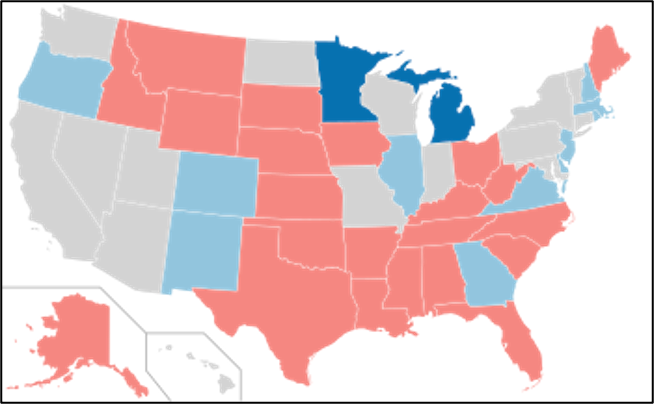
Referencing the map above, 35 seats are up for grabs in the Senate. Seats in red are held by a GOP incumbent, and seats in blue are held by a Democrat incumbent. The dark blue shades over Minnesota and Michigan reflect the coming retirements of Democrats Tina Smith and Gary Peters, respectively. Already I can tell you, barring an electoral and political catastrophe of some sort no one could possibly predict at this point, the only red seats that even remotely appear competitive are North Carolina and Maine. Thom Tillis of North Carolina will probably take on a primary, but the good news here is that he will turn into a hardcore MAGA man for the next 21 months trying to get back in there. The risk there is getting someone like Mark Robinson over him in primaries. Collins has run the gauntlet in Maine and survived over and over again, and as much as I hate the line, “Collins is the only Republican who can win in Maine so we have to keep her,” it’s probably the truth, especially considering the fact that Maine has the worst elections in New England, bar none.
Six of those blue seats are wastes of time, energy, and money (you’ll have to wait a while for more detail), and in my view, Georgia, New Jersey, Virginia, and New Hampshire are the ones most worth targeting. Right now, it appears the most likely outcome is that Trump will enter the second half of his term with 52 to 55 seats in the Senate (which should be higher if not for the fraudulent Senate outcomes down ballot in 2024 in as many as four states).
Clearly, the House represents the biggest hill to climb.
III. 2026 Dynamics in Play
There is also the increasingly likely possibility that we may find ourselves tossing the historical playbook out the window, just like Americans did when politics changed forever after the onset of the Great Depression. After all, we are due for a major, long lasting realignment that has been trying to come out from behind the rampant ballot harvesting and mail fraud abuse over the last six years, and since elections are decided by small margins and change courses on the initially minor coalition shifts (see Florida’s transformation from 2016 to 2024), we could be in for a surprise.
As I wrote last month, they haven’t learned a damned thing. While gains in the House are extremely difficult for the President’s party to pull off, it isn’t entirely unprecedented. If Democrats keep insisting on putting tampons in boys’ bathrooms instead of figuring out why they’re losing working-class voters of all races and ethnicities now, while simultaneously pissing off the feckless soccer moms who now support their idiotic candidates, and Republicans continue to sharpen digital messaging and get-out-the-vote methodology, they (Democrats) could find themselves on the wrong end of a midterm reckoning. I see no way they’re going to flip the Senate, so the GOP needs to focus all of its energy on going after vital House seats and defending those that are on the fringe, like AZ-6, which Congressman Juan Ciscomani (my U.S. Representative) referred to recently as “Seat 218.” President Trump’s comments last week about coming election reforms (put me in, boss) suggest we may be bogged down in legal turmoil in the run-up to the midterms as blue states attempt to skirt any executive reforms to our extremely unfair elections.
The biggest signs that I may be onto something here (that the Democrats are verging on extinction) are the resignations of Smith and Peters, who should be capable of holding their seats as Senate incumbents in two states that have horrific election situations (Michigan has 83% of its population registered to vote when only 77% of any statewide population is over the age of 18), as well as Gretchen Whitmer’s disinterest in running for Peters’ open seat despite having held what will have been two terms as governor by then. It is possible Democrats, in their insanity and amidst Trump’s increasing popularity, have created battleground states out of light blue states and pushed battlegrounds into red states, like we’ve seen in the case of Iowa over the past decade. The seemingly impossible continuation of Republican voter registration trends has only accelerated since November.
Conclusion
We are way too far out for any detailed predictions, but rest assured, if I’m still breathing, you’ll get them when the time comes. Unlike polling addicts, I evaluate each race based on precedent, current law, political science, voter registration trends, and my estimation of the capacity for fraud in each race. If Republicans don’t hold the Senate, it will be one of the biggest political botches in history; the battle for the U.S. House is where the rubber meets the road. And to absolutely no Captain K’s Corner reader’s surprise, election integrity is still king and is the key to electoral dominance for this new coalition moving forward.
On a more direct note – if you are a consultant, campaign lead, or even a candidate reading this article who is sick and tired of hiring the same deadbeats who pay for overpriced polling and can’t read a registration trendline, then reach out to me at skeshel@protonmail.com and hire me to provide sanity, clarity, and legitimate counsel to your campaign. I have found myself unwelcome at the big boys’ consulting table for some time because I am the only analyst out there who blends traditional political analysis with my own self-taught ability to detect and plan for cheating in your races. My fees will also be much more palatable than those of the people you’re accustomed to robbing you blind.
There are lots of perks in my referral program. Click the button above to learn more.
Seth Keshel, MBA, is a former Army Captain of Military Intelligence and Afghanistan veteran. His analytical method of election forecasting and analytics is known worldwide, and he has been commended by President Donald J. Trump for his work in the field.
Gary Peters DID NOT win his Michigan Senate seat in 2020.
It was stolen for him.
John James never should have conceded.
You’ve paid a lot of dues, Seth. There’s a payday ahead.