


Last month, I wrote an article outlining the uphill challenge Democrats face in seeking to obtain a majority in the United States Senate. That article is open for all readers:
End of June 2026 Senate Majority Race Update

Yesterday, I whittled down the battle for the U.S. House majority to 23 decisive races. It’s going to be close, no matter how you slice it:
Here are the nine races that will determine which party wins the chamber majority:
Key Races
Georgia (Jon Ossoff - D, incumbent)
Maine (Susan Collins - R, incumbent)
Michigan (Democrat-held, incumbent retiring)
New Hampshire (Democrat-held, incumbent retiring)
North Carolina (Republican-held, incumbent retiring)
Second-Tier Races
Alaska (Dan Sullivan - R, incumbent)
Iowa (Republican-held, incumbent retiring)
Ohio (Jon Husted - R, incumbent)
Texas (Republican-held, incumbent defeated in primary)
Democrats could win all five key races, which I do not consider likely given the strength of Susan Collins in Maine, a developing race against a radical DSA-aligned candidate in Michigan, and the Sununu name in New Hampshire. But let’s say they do win them all. That would have Republicans in the lead 51 to 49, requiring Democrats to win two of Alaska, Iowa, Ohio, and Texas for a clear majority. They have a pathway to victory; but it’s not a realistic one.
Today, I have done the research and I’m going to demonstrate why I consider the Republicans a strong favorite to hold the Senate.
Trump 2024 Margins for Second-Tier Races
Alaska +13.1%
Iowa +13.2%
Ohio +11.2%
Texas +13.7%
2022 Midterm Analysis
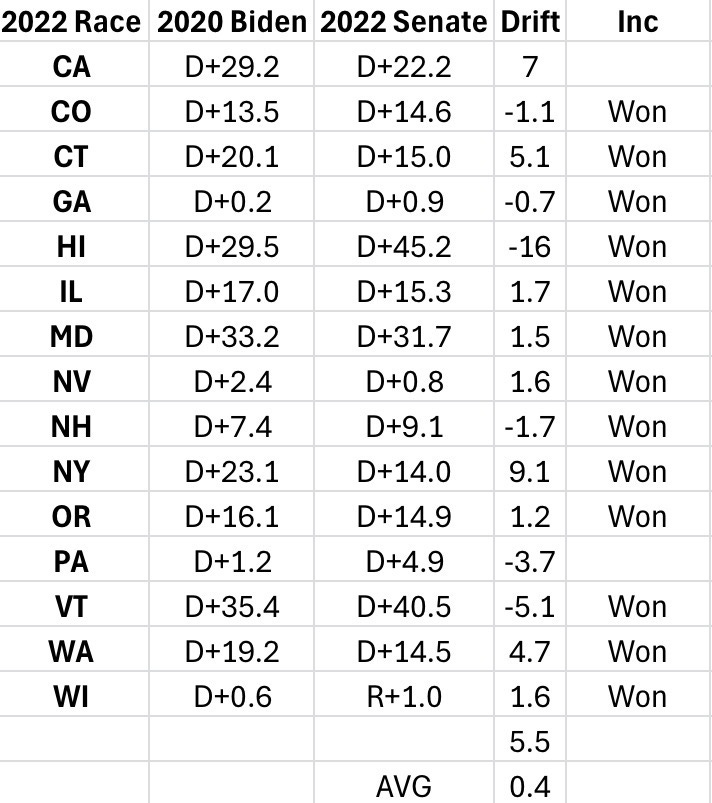
All analysis is from the perspective of the president’s party, given that we are facing a GOP-president midterm in November.
Here’s how to read the table above, using California as the example. In 2020, Joe Biden won California by a certified margin of 29.2% (yes, I know, it is artificially inflated). In 2022, the Democrat Alex Padilla won the Senate seat by 22.2%. That is seven points to the right of the 2020 presidential margin, indicated by a positive number in the “drift” column. Padilla was not an incumbent.
The table includes 15 Senate races, all in states Biden carried in 2020. The only state Biden won (“won” in this case) in which the Republican won in 2022’s Senate contests was Wisconsin, and incumbent Ron Johnson held his seat 1.6% right of the 2020 presidential margin.
Incumbents held 13 of 13 seats in Biden-won states.
9 of 15 seats had rightward drift from the 2020 presidential election.
Hawaii is the extreme outlier with leftward drift of 16.0%, driven by a weak Republican challenger to a strong Democrat incumbent (Schatz). Even keeping this outlier in the numbers, the average drift in these 15 Biden seats comes out to 0.4% rightward. This underscores why 2022 was a “pink trickle” rather than a red wave, and should help you understand why many are pondering if 2026 will be like a “reverse 2022” (Democrats expecting big gains but disappointed in outcome).
Hawaii excluded, none of the Senate seats won by the president had enough drift in either direction to flip any of the second-tier Senate races up in 2026.
2018 Midterm Analysis