


Yesterday, I whittled down the battle for the U.S. House majority to 23 decisive races. It’s going to be close, no matter how you slice it:
Preliminary Evaluation of the 22 “Leaners” on the U.S. House Map

You can get it right, and people forget about you the next day and call you crazy when you pop your head up for another round of predictions. That’s life in forecasting elections and world events. Slow and steady wins the race, and dumping entire models to keep up with
While most consider the House the most likely chamber to flip control, far fewer feel the same about the Senate:
The reasoning is simple - only 35 Senate seats are up this cycle, and the map is a monster for Democrats.
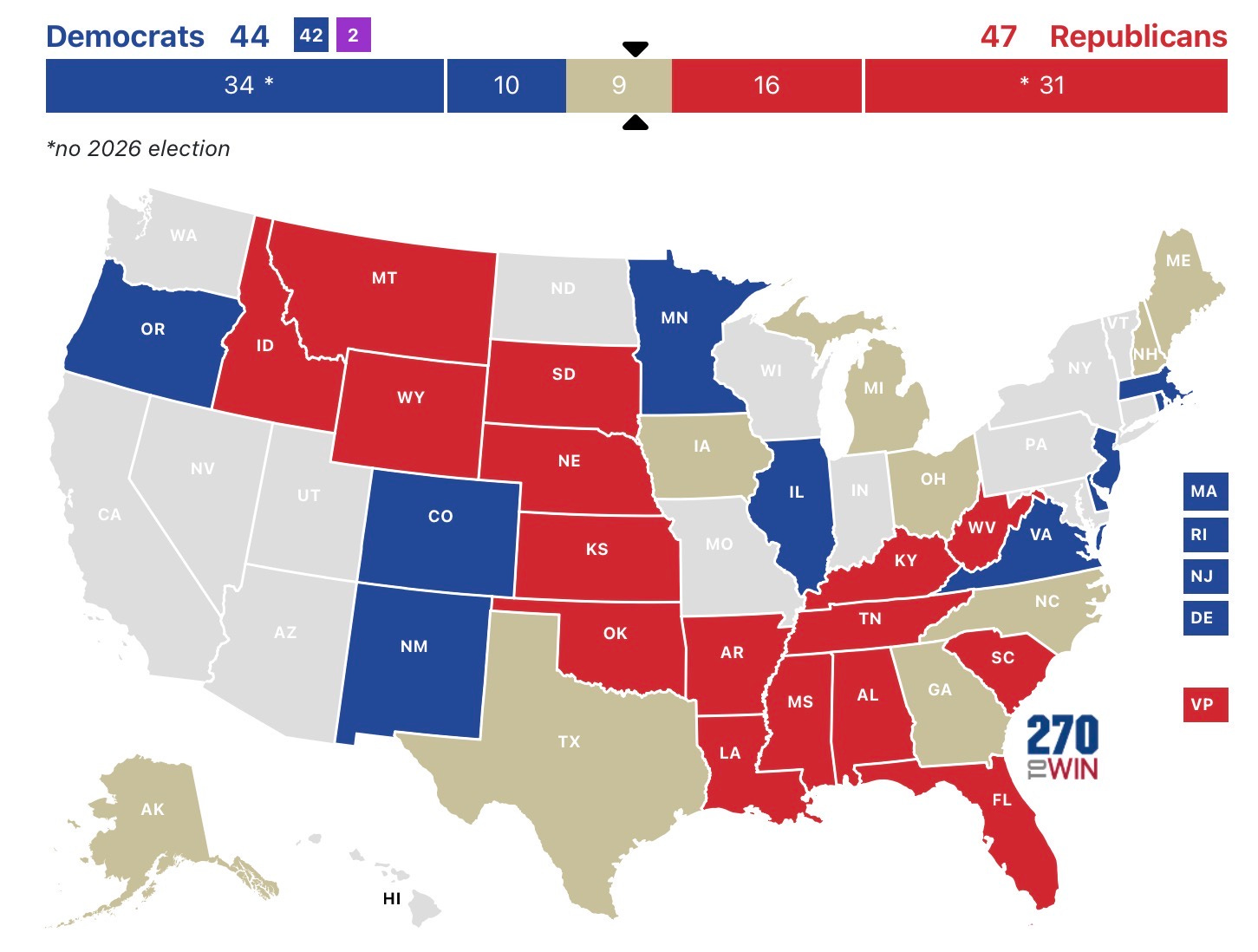
Republicans have a stranglehold on 16, and Democrats on 10. That leaves nine Senate races ostensibly in play. I divide them into two camps for now:
Key Races
Georgia (Jon Ossoff - D, incumbent)
Maine (Susan Collins - R, incumbent)
Michigan (Democrat-held, incumbent retiring)
New Hampshire (Democrat-held, incumbent retiring)
North Carolina (Republican-held, incumbent retiring)
Second-Tier Races
Alaska (Dan Sullivan - R, incumbent)
Iowa (Republican-held, incumbent retiring)
Ohio (Jon Husted - R, incumbent)
Texas (Republican-held, incumbent defeated in primary)
Republicans currently hold a 53 to 47 majority in the Senate, which would be much larger if we had fair elections. You can read my book, The American War on Election Corruption, if you’d like more detail on that matter.
How the Math Shakes Out
If the Democrats win all five key races:
51 to 49 Republican.
I do believe Michael Whatley is in deep doo-doo in North Carolina against former Democrat Governor Roy Cooper, and as such, is running for the most likely GOP-held seat to be lost. Thom Tillis didn’t do anyone any favors with his miserable tenure in the Senate, but Whatley doesn’t appear to know his ass from a hole in the ground when it comes to appealing to voters - and he has ignored election integrity-minded patriots for years. Still, North Carolina prefers federal Republicans, so I doubt Cooper has a high ceiling, and I wouldn’t be surprised to see the race tighten.
I’ve written extensively about Susan Collins, and why I think she is likely to hold her seat:
“But the Polls” - Maine Edition

Many of you know I couldn’t care less about what polling says. I’ve even leveled up to the point where I don’t care what polling says when it is good for my side. I subscribe to the “campaign like you’re ten points behind” school of thought and care more about what the winds of history and the science of voter registration change tell me about an election.
Michigan is no “gimme” for the Democrats, because they appear to be on the verge of nominating an Islamic extremist against Mike Rogers, who would have won his seat in 2024 if not for late-counted mail-in ballots arriving en masse immediately after Trump was declared the winner of the state. New Hampshire will be a fairly tight race, but Democrats definitely have the edge in a Republican president’s midterm. Likewise, with Ossoff a clear favorite, Democrats don’t have the ceiling clearance to coast in Georgia and will need to spend big there to make sure they don’t get upset.
I think the most likely outcome of these five races is Republicans hold the line with 52 or 53 seats, depending on the result in Michigan.
If, if, if, if (and a big if) Democrats win all five key races:
They will need to win two of Alaska, Iowa, Ohio, and Texas to take a 51 to 49 Democrat majority.
Now you understand why the math doesn’t math well for them.
Conclusion
The Democrats can take a Senate majority this year. The only problems for them are that they must win all five key races, and then take two Senate seats out of solid Republican states, and that Senate races (as evidenced by the blue wave in the House in 2018, but a +2 gain for the GOP in the Senate) are less volatile and likely to swing like House districts.
I will keep everyone apprised of these races as time elapses. Your paid support of this newsletter is greatly appreciated.
Seth Keshel, MBA, a former Army Captain of Military Intelligence and Afghanistan veteran, is the author of The American War on Election Corruption. His analytical method of election forecasting and analytics is known worldwide, and he has been commended by President Donald J. Trump for his work in the field.
Captain K’s Corner is a Polymarket partner newsletter.
The Senate is harder to fake with vibes than the House. Statewide races are bigger, less volatile, and less forgiving of fringe nominees. Democrats have real opportunities, especially in North Carolina and Georgia, but the ceiling problem is severe. Collins remains a Maine institution. Michigan is not a gimme. Texas is still Texas. Ohio is not easy. Alaska is complicated. Iowa is redder than the press admits. Republicans should not get cocky, but they should understand the board. Hold the line, spend smart, fix election operations, and force Democrats to defend every inch of an ugly map.
On the loss of stolen senate seats to election fraud, what is it about that concept that Thune and the rino's don't understand? Are they so naive as to think these are not rigged elections? If so, I'd have them explain the election anomalies nobody else can. Rather that dodging the SAVE Act, they ought to be moving heaven and earth to get it passed. Whatever it takes!