


Author’s Note: For a summary of why voter registration by party is so important, and to understand the importance of these states and why each were selected for this recurring study, please see the March 2025 summary.
Last month’s report can be found here.
Your support of this newsletter is critical and worth your time and money. Please support my efforts by becoming a paying member of this newsletter:
FLORIDA
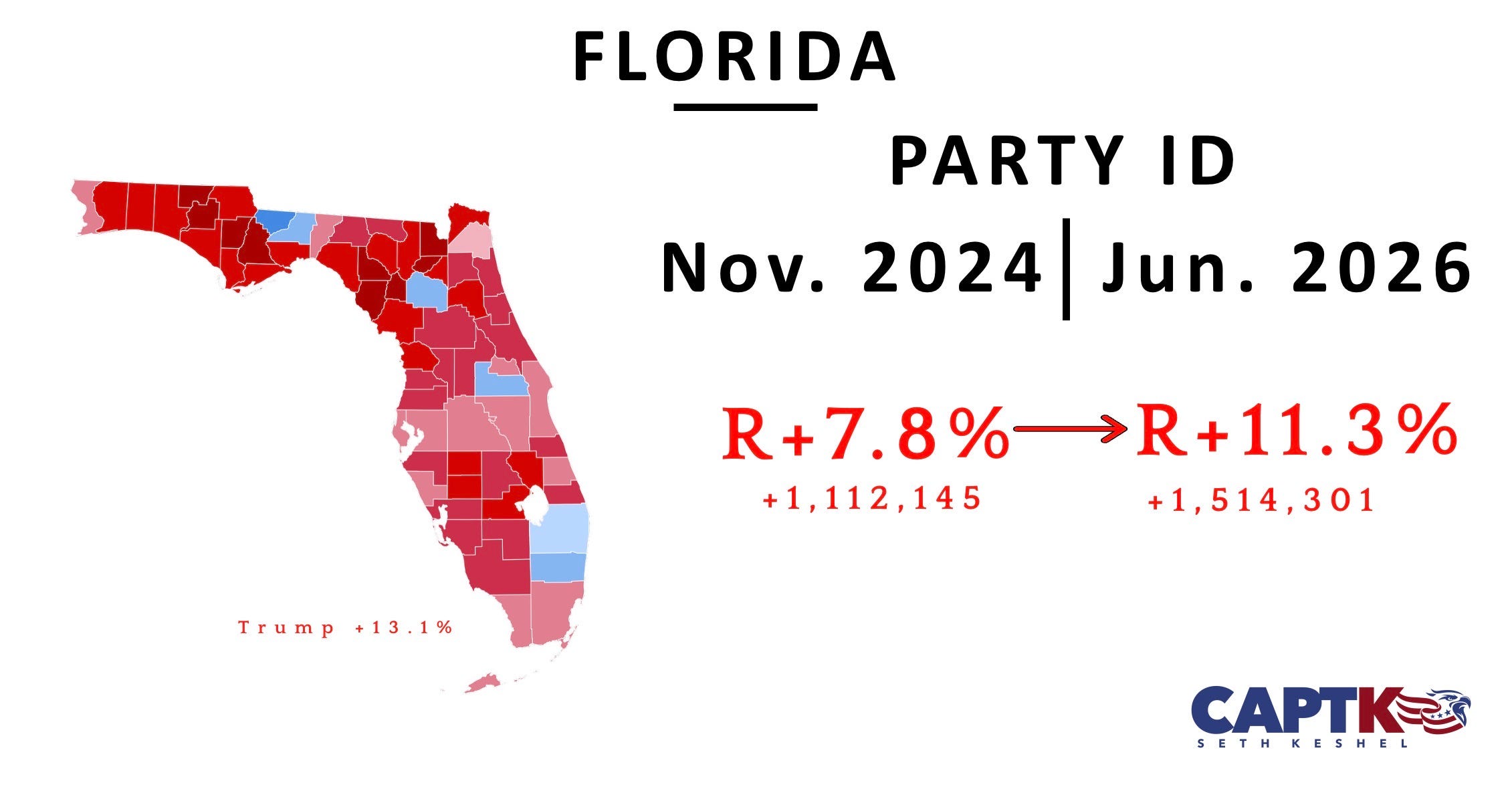
Net Shift Since May: R+8,830
If you’d like to understand just how screwed Democrats are long-term in Florida, consider the fact that most states in this sample of seven are showing (or have shown) some signs of life for Democrats, even if only for the run-up to primary elections. This is not happening in Florida at all, as Democrats fell further back in May than they did in April.
Florida’s drift is predictive for Pennsylvania and Michigan since 1952, portending good things for future GOP campaigns in both of those battlegrounds in the next presidential election. Florida appears to be emerging as the premier GOP superstate, passing Texas (although not in order of importance by electoral votes and House seats).
IOWA
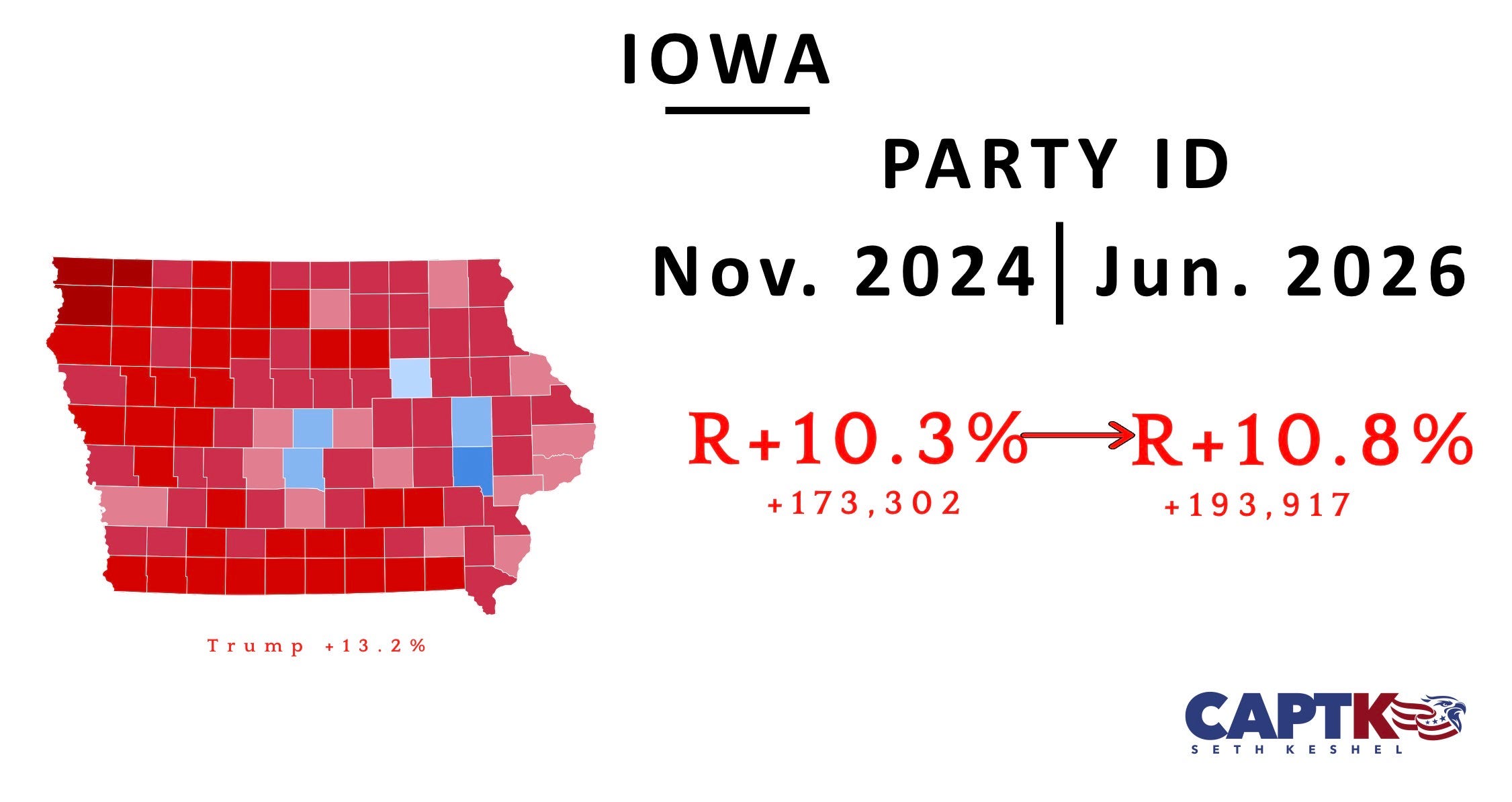
Net Shift Since May: D+1,953
April’s shift was the first technical gain for Democrats in raw registrations since I’ve been tracking these figures, but they still managed to fall further back as far as percentage of voter registration thanks to maintenance that winnowed both parties’ memberships. In May, Democrats made their first legitimate gain since I’ve been covering these on a monthly basis, both in raw numbers and by percentage.
The pro-Democrat shift is tied exclusively to the Iowa primaries, which concluded last week. Republicans made nice gains as well, so I would wager this is a blip in a long-term trend, not a reversion of Iowa to battleground status. Democrats were nominating statewide candidates and four U.S. House candidates, while Republicans were only nominating two House candidates.
Iowa has two competitive U.S. House races this year; most importantly, the state tracks with Wisconsin and Minnesota as a proxy, given that those two states don’t register voters by party. The majority could be won or lost for the GOP depending on how IA-1 and IA-3 shake out.
PENNSYLVANIA
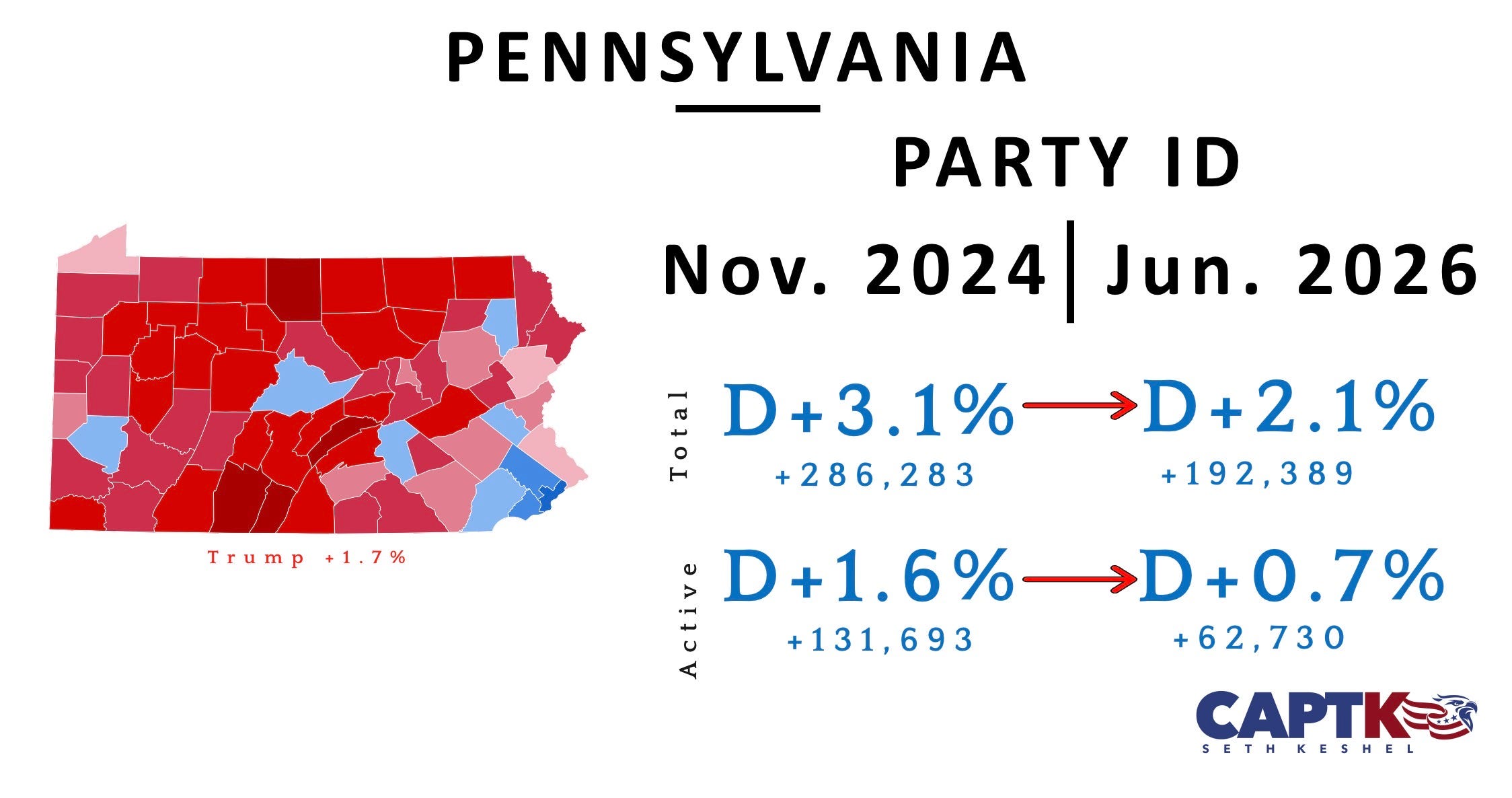
Net Shift Since May: D+4,008 Total, D+5,668 Active
The best news you’ll read in this month’s report, believe it or not, is that Pennsylvania’s figures only reflect the gains above. They are down from the past two months because the Pennsylvania primaries have come and gone - as I’ve been predicting and noticing in county-by-county numbers. See the comment from last month:
Just as I explained last month, these numbers do not make sense based on registration trends elsewhere, even in places where Democrats are making temporary gains. In fact, I see no possibility that Oregon should be making Republican gains (it is) but Pennsylvania would be having a genuine change of course unrelated to an approaching election. Most of this shift appears to be Philadelphia-centric, and validating my point is the fact that Erie County has shifted Republican in the last quarter (since the February update), and Northampton County is generally treading water. There does not appear to be a legitimate coalition shift away from MAGA in Pennsylvania with the working-class voter.
Republicans have held their own in the two weeks since primaries ended, and the Erie and Northampton bellwethers are largely unchanged. Party switchers have favored the GOP in the past two weeks, and I suspect the bleeding will stop moving forward. Pennsylvania sits significantly to the right of its November 2024 numbers.
NORTH CAROLINA
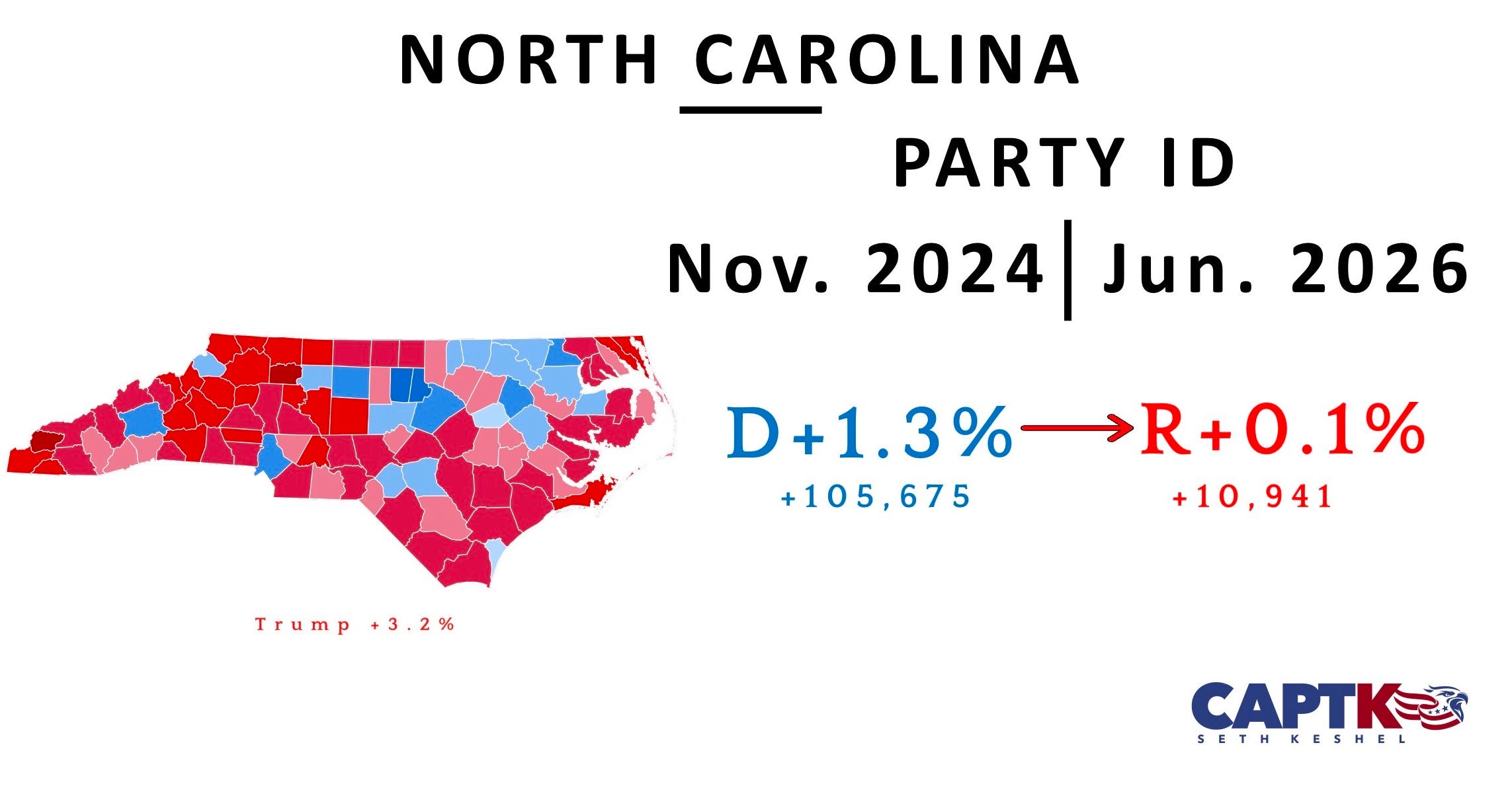
Net Shift Since May: R+179
The North Carolina GOP again made a narrow lead in the voter roll with primaries in the rear view mirror. The overall lead is now 116,616 to the right of the former GOP deficit at the time of the November 2024 election.
With former Democrat Governor Roy Cooper running for U.S. Senate, Republicans need all the help they can get. I consider the GOP-held seat in North Carolina the most likely to flip to Democrats in 2026, with Michael Whatley the Republican nominee.
NEW HAMPSHIRE
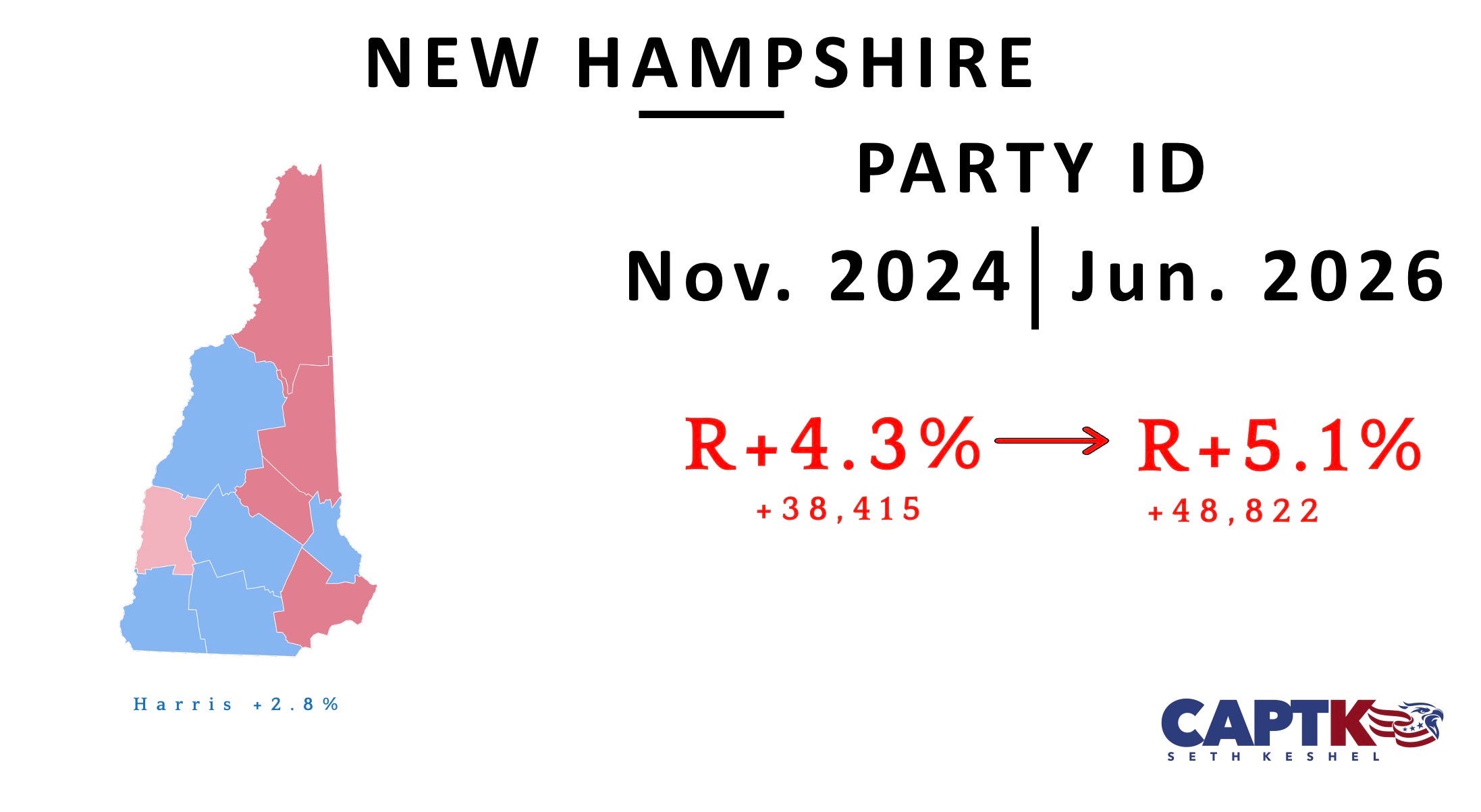
Net Shift Since May: No Update
New Hampshire releases quarterly updates, and no update is due until August.
The Granite State remains the most likely Republican flip for the 2028 presidential election, and has several important races on the ballot in 2026, like a U.S. Senate seat and the battle for NH-1, which Democrat Chris Pappas will vacate to run for said Senate seat.
ARIZONA
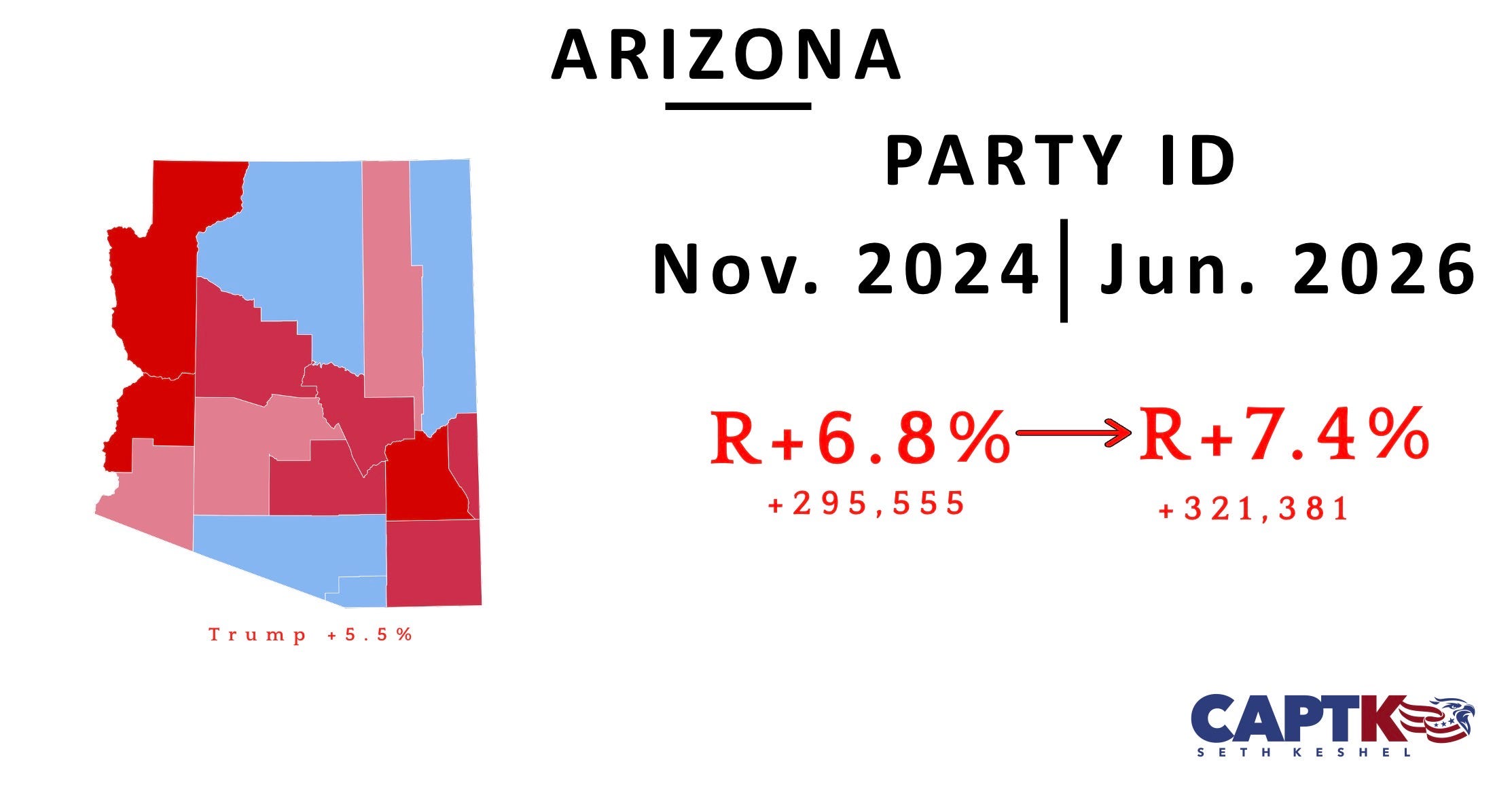
Net Shift Since May: No Update
I can view registrations change weekly in Pima County and around-the-clock in Maricopa County, but am now shifting this model to update on official Secretary of State releases, which come quarterly. This is to ensure the whole picture is painted, rather than having you see it through glimpses - which can either be overly encouraging or discouraging in these incomplete blips.
Democrats have been making up significant ground in Maricopa County with primaries around the corner (July 21), but I suspect that is the why here - not a long-term reversal of electoral trend. Arizona’s statewide offices are up for grabs this year, and the Democrats have a real shot at flipping the legislature for the first time since the 1960s, so the battle for voter registration looms large.
NEVADA
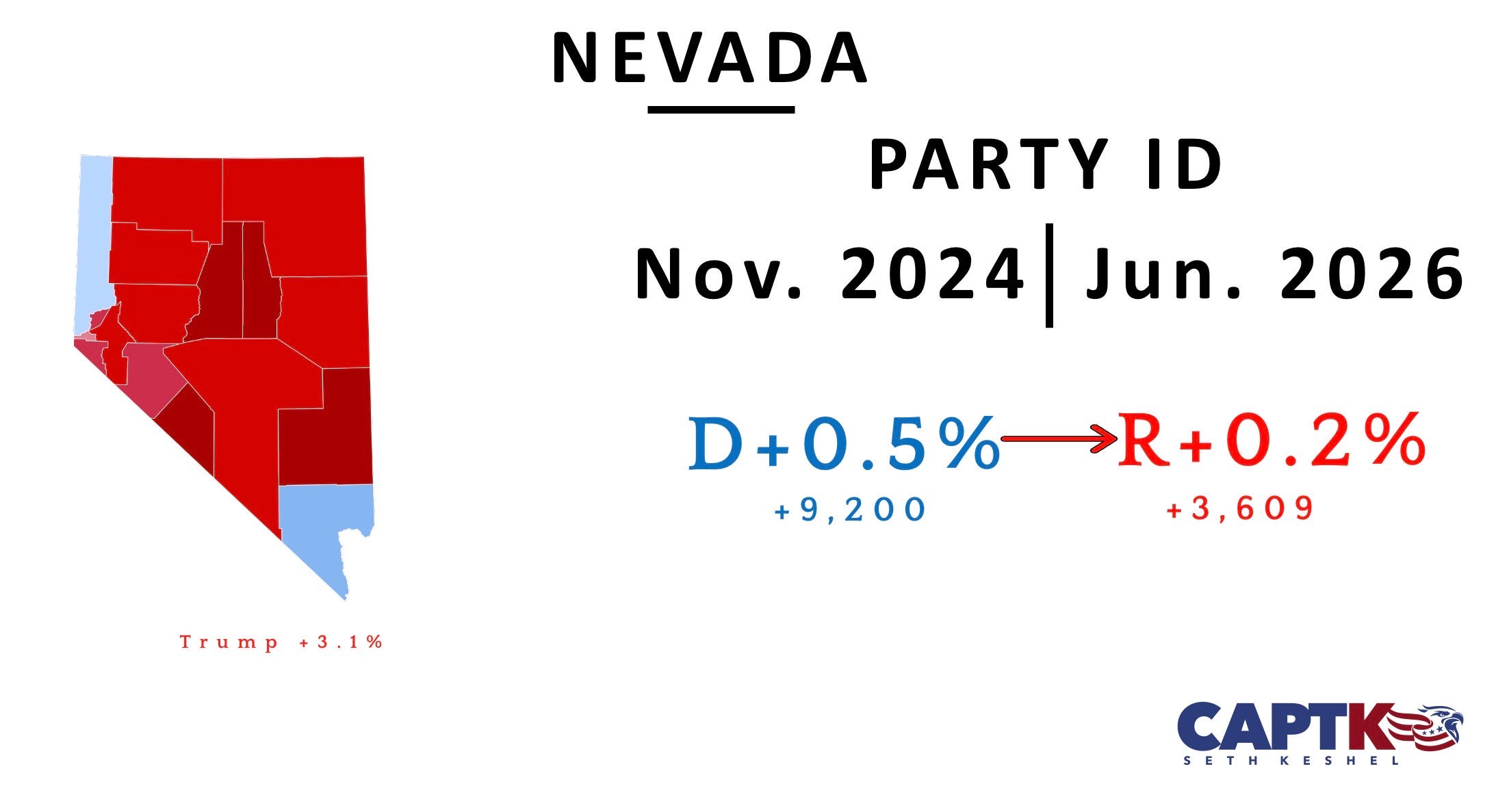
Net Shift Since May: D+2,135
June 9 is almost here (Nevada primaries), and with it, we should see an end to the monthly Clark County onslaught. Clark was again responsible for nearly the entirety of Democrat gains in May. Republicans cling to a narrow voter registration edge of +3,609 - or +12,809 right of when Trump won the state by 3.1% in November 2024.
Nevada has its statewide offices up for grabs this year, plus at least one potentially competitive House seat. With over two-thirds of the statewide vote coming from Clark County, it is an obvious focus area for the GOP that must not be neglected.
Seth Keshel, MBA, a former Army Captain of Military Intelligence and Afghanistan veteran, is the author of The American War on Election Corruption. His analytical method of election forecasting and analytics is known worldwide, and he has been commended by President Donald J. Trump for his work in the field.
This is not just horse-race trivia. Voter registration is infrastructure, and infrastructure decides whether the Red-Green coalition and its Democrat enablers can be stopped before they burrow deeper into American institutions.
Florida is the model. The state’s official data confirms Republicans hold a large active-voter registration advantage over Democrats, which matches Keshel’s argument that Florida has become the premier GOP superstate. That matters because Florida is not merely a state. It is the proof of concept for what happens when people flee blue-state decay, reject the politics they escaped, and register accordingly.
Nevada is the warning light. Keshel notes Democrats gained in May, largely out of Clark County, and Republicans still hold only a narrow registration edge. That means the state remains a live battlefield where ballot mechanics, registration drives, and urban political machinery matter. Pennsylvania is the stress test. Official state resources track county-level registration by party, and the real question is whether temporary primary-season Democratic gains fade once the campaign machinery cools.
North Carolina remains dangerous because the Senate race is real, the voter rolls are close, and the state board publishes updated registration data weekly. Keshel’s point that Republicans need every advantage there should be taken seriously.
The larger point is this: the Democrat Party is no longer just another party with different tax policy. It is the political vehicle enabling the Red-Green coalition, open-border pressure, DEI rule, anti-police agitation, anti-Israel radicalism, and institutional capture. Registration is one of the places where that machine can be measured and confronted. Watch the rolls. Build the rolls. Defend the rolls. Lose the rolls, and the rest follows.
Washoe Co. NV update, 6/5/26 - Active Registered data, 91,724 Dems; 101,769 Rep; 104,793 NP; 23,009 Other = 321, 355 Total Voters. 322,132 Mail Ballots sent. More Ballots than Voters. Trump won Clark Co. and Washoe Co. on Election Day 2024. However, after Election Day, kept counting Mail-in Ballots in Clark and Washoe, and Trump lost in both Washoe and Clark, but still won the state for Electoral Vote.